

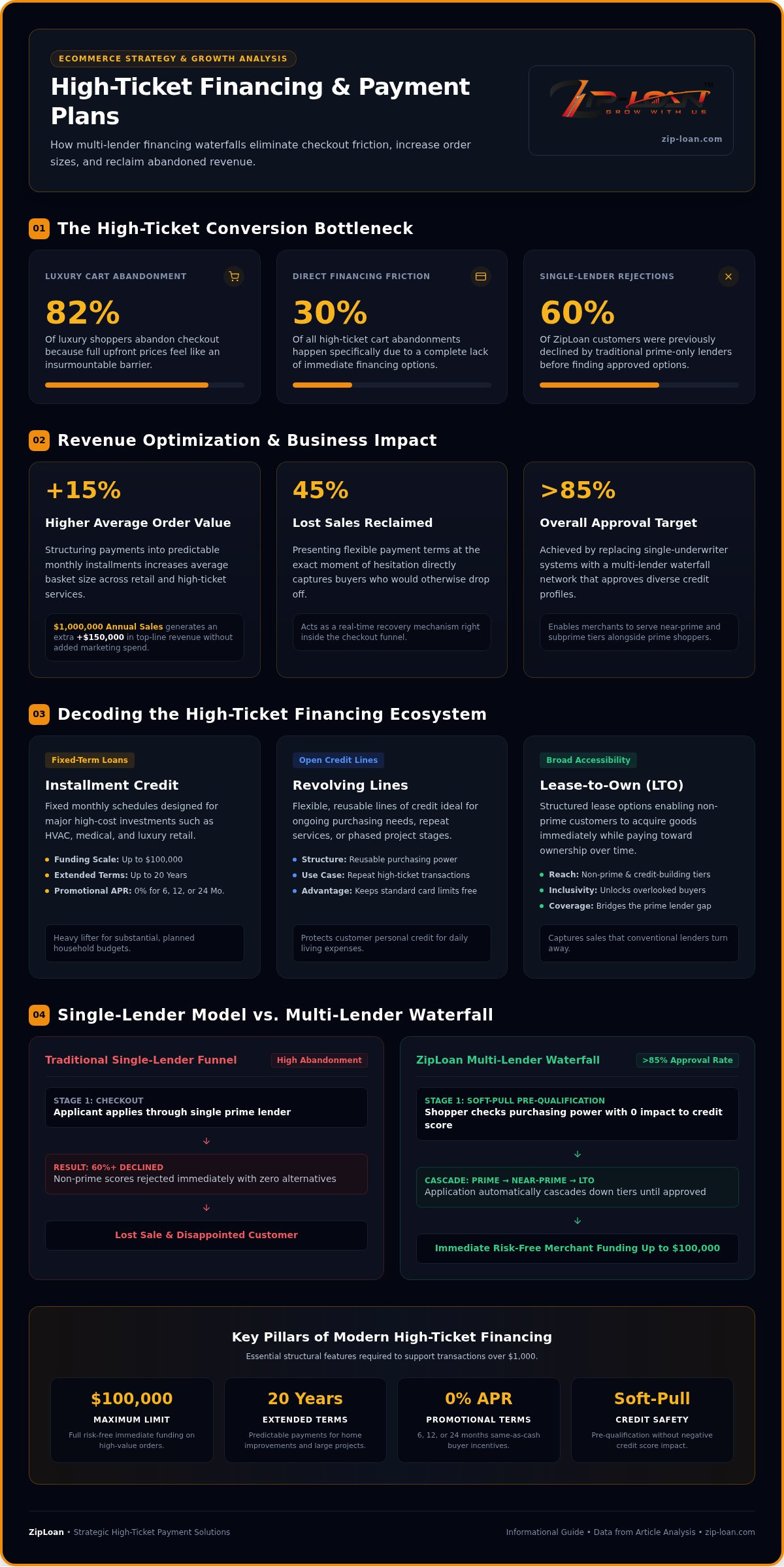
Did you know that over 82% of luxury shoppers abandon their carts because the price tag feels like an insurmountable wall? For high-ticket merchants, this isn’t just a lost sale; it’s a symptom of a rigid checkout experience that fails to meet modern consumer expectations. Finding the best payment plan for ecommerce often feels like a frustrating trade-off between high fees and disappointing approval rates. You likely agree that watching a $5,000 sale vanish because a traditional lender declined a qualified buyer is a significant barrier to your growth goals.
This guide shows you how to dismantle those barriers and transform your checkout into a powerful engine for expansion. You’ll discover how to implement the most effective ecommerce payment plans to boost conversion rates, increase average ticket sizes by 15% or more, and achieve approval rates exceeding 85%. We’ll examine the shift toward multi-lender waterfall systems that provide immediate funding for your business while offering your customers the flexible, low-friction credit they demand in 2026. It’s time to unlock your business’s latent potential and ensure no customer is left behind due to limited financing options. By aligning with a partner like Zip-Loan, you can bridge the gap between a customer’s aspiration and their final purchase decision.
Key Takeaways
- Learn how to shift your customer’s focus from the total purchase price to manageable monthly payments, effectively reducing high-ticket cart abandonment.
- Discover the specific criteria for selecting the best payment plan for ecommerce based on your unique industry, order values, and customer credit profiles.
- Understand the strategic differences between installment credit, revolving lines, and lease-to-own programs to optimize your sales funnel.
- Explore how a multi-lender “waterfall” architecture can drive customer approval rates above 85% by creating a competitive underwriting environment.
- Find out how to implement a risk-free financing solution that provides immediate funding for sales up to $100,000, ensuring your business scales without friction.
Beyond the Credit Card: Why High-Ticket Ecommerce Needs a Strategic Payment Plan
High prices often create a psychological wall that stops even the most interested buyers. For merchants selling products over $1,000, relying on a simple credit card field is no longer enough to sustain growth. Data shows that 30% of shoppers abandon high-ticket carts specifically because they lack immediate access to financing. Finding the best payment plan for ecommerce means looking beyond standard processing and focusing on purchasing power. When you shift the conversation from an intimidating total price to a manageable monthly payment, you remove the primary friction point in the buyer journey.
To better understand how these financial mechanisms drive retail expansion, watch this analysis from The Wall Street Journal:
The High-Ticket Conversion Problem
The ROI of Flexible Payments
Implementing a robust financing strategy isn’t just about convenience; it’s a direct catalyst for revenue optimization. Merchants who offer structured payment plans typically see a 15% increase in average order size. For a business doing $1 million in annual sales, that 15% bump translates to an extra $150,000 in top-line revenue without increasing marketing spend. Beyond larger baskets, the right plan acts as a powerful sales recovery tool. Industry data suggests that up to 45% of lost sales can be reclaimed simply by presenting a flexible payment option at the moment of hesitation. The best payment plan for ecommerce ensures that your business captures every possible dollar while providing a professional, empowering experience for the customer.
Decoding Modern Financing: Installment Credit vs. Revolving Lines vs. Lease-to-Own
The best payment plan for ecommerce isn’t a single product; it is a versatile ecosystem designed to capture every lead. To reach an approval rate that exceeds 85%, your checkout must offer a strategic mix of financial tools. A key differentiator in modern high-ticket retail is the use of “soft-pull” pre-qualification. This mechanism allows shoppers to discover their purchasing power early in the sales funnel without any impact on their credit score. By removing the anxiety of a hard credit inquiry, you build immediate trust and keep the momentum moving toward a completed sale.
Installment Credit: The Heavy Lifter for Big Projects
Installment credit is a fixed-term loan that simplifies high-cost acquisitions by breaking them into predictable, manageable monthly payments. For major investments like home improvements or medical procedures, these plans can offer terms up to 20 years. This longevity makes even a $100,000 project feel accessible to the average household budget. You can also leverage 0% promotional APR options for 6, 12, or 24 months to act as a “same-as-cash” incentive. This appeals to savvy buyers who have the capital but prefer the strategic advantage of interest-free liquidity.
Lease-to-Own and Revolving Options
While installment loans serve the prime market, Lease-to-Own Programs provide a vital “no credit needed” path for customers with scores as low as 550. These programs rely on income and banking history rather than traditional credit metrics, allowing you to approve a demographic that your competitors likely ignore. This expansion happens without increasing your merchant risk, as the financing partner carries the liability. On the other end of the spectrum, Private Label Revolving Credit creates a dedicated line of credit for your brand. This encourages repeat business and builds lasting loyalty, as customers are more likely to return to a merchant where they already have an established spending limit.
Recent research, including a CFPB report on retail installment lending trends, highlights how these diversified credit models are reshaping consumer behavior. By offering a combination of fixed-term loans, revolving lines, and leases, you ensure that every visitor, regardless of their financial background, has a viable path to purchase. If you want to see how these products can be integrated into your specific workflow, reach out to Zip-Loan for a customized growth strategy.
Evaluating the Best Payment Plan for Your Specific Business Model
Selecting the best payment plan for ecommerce requires a deep understanding of your specific vertical and average order value (AOV). While generic retail platforms focus on $50 purchases, high-ticket industries like contracting or healthcare demand a more sophisticated approach. A recent McKinsey study on point-of-sale financing models suggests that the most successful merchants align their credit offerings with the consumer’s expected repayment horizon and the total project cost. This alignment removes the hesitation often found in high-consideration purchases.
For contractors and home improvement professionals, long repayment terms and instant funding are non-negotiable. You can’t wait weeks for a check when materials and labor costs are due. In the healthcare sector, patient financing must prioritize transparency, featuring secure dashboards and zero pre-payment penalties to maintain trust. Meanwhile, retail and auto-repair shops often find success using 12-month promotional periods to compete with big-box national chains. These promotions act as a powerful hook, allowing you to capture market share from competitors who only offer standard credit card processing.
Matching Plan Types to Ticket Sizes
Purchasing power needs vary wildly across the $1,000 to $100,000 spectrum. For tickets between $1,000 and $5,000, revolving credit lines or Lease-to-Own Programs often provide the necessary flexibility for quick decisions. However, once a project exceeds $5,000, installment loans become the primary driver for conversion. These structured loans offer the stability consumers need for major life investments. You can explore tailored solutions for your specific vertical by reviewing the industries we serve to see how these frameworks apply in practice.
The Merchant Discount Fee Debate
Many business owners hesitate when they see a 2.99% merchant discount fee. It’s vital to weigh this cost against the alternative of a lost $10,000 sale. If a small fee facilitates a transaction that wouldn’t otherwise happen, the ROI is undeniable. Some advanced platforms even offer a “Discount Fee FREE” model. This approach allows you to protect your margins by passing the cost of financing to the lender or the consumer through specific loan structures. Choosing the best payment plan for ecommerce means finding a partner that offers this level of transparency, ensuring your growth remains both profitable and sustainable.
Maximizing Approval Rates: The Power of Multi-Lender Financing Platforms
Single-source financing is a growth bottleneck. If your checkout relies on a single lender, you’re essentially gambling on a very narrow slice of the market. The best payment plan for ecommerce creates a competitive underwriting environment where multiple institutions vie for your customer’s business. By aggregating 30 different lenders into one portal, you remove the “declined” dead end that kills momentum. When one lender says no, the application automatically cascades through a sophisticated waterfall system to find a match.
This waterfall effect is the engine behind achieving an 85%+ approval rate. It moves the application from prime lenders down to near-prime and sub-prime specialists in milliseconds. This allows you to serve the full credit spectrum, including customers with scores as low as 550, without requiring the shopper to fill out multiple forms. It’s a seamless transition that preserves the customer’s dignity and your conversion rate. You aren’t just offering a loan; you’re providing a bridge to a “yes” that traditional lenders frequently miss.
Soft-Pull Pre-Qualification: Removing the Barrier to Entry
Soft credit pulls are the ultimate barrier-remover in the modern customer journey. They allow shoppers to see their monthly payment options early, letting them shop with confidence without any impact on their credit score. Modern tools like QR codes and text-to-apply features integrate this directly into your sales process. A customer can scan a code in a showroom or click a link in a quote and get pre-qualified while they’re still in the consideration phase. This transparency builds trust and significantly reduces the friction typically associated with high-ticket financing.
Instant Approvals and 24-Hour Funding
Velocity is the currency of high-ticket sales. Data indicates that 9 in 10 customers demand an approval decision in seconds, and anything longer leads to hesitation, which often results in abandonment. A multi-lender platform delivers these instant results and pairs them with 24-hour funding for the merchant. You receive the full payment for the sale immediately, while the lender assumes all the risk and handles future collections. This ensures your cash flow remains fluid and your business stays protected from the volatility of consumer debt.
Speak with a financing expert to maximize your approvals
Unlocking 100% Purchasing Power with ZipLoan’s Financing in a Box
Scaling a high-ticket business requires a financial partner that understands the complexity of large-scale transactions. ZipLoan provides a comprehensive “Financing in a Box” solution that consolidates 30 lenders into a single, streamlined portal. This platform eliminates the need for multiple integrations by offering Installment Credit, Private Label Revolving Credit, and Lease-to-Own Programs in one location. By providing this variety, you can confidently offer the best payment plan for ecommerce to every customer who walks through your digital or physical doors. With instant automated approvals for tickets up to $65,000 and total financing capabilities reaching $100,000, you have the tools to capture the largest projects in your pipeline.
One of the most significant advantages of this ecosystem is the “No Credit Needed” path provided by our lease-to-own options. This feature allows you to broaden your customer base to include individuals with credit scores as low as 550, a demographic often ignored by traditional banking. Because ZipLoan assumes all the risk, your business remains 100% protected while you receive full payment for your sales within 24 hours. Getting started is effortless; merchant enrollment is free and includes access to POS advertising assets designed to signal your flexible payment options to every visitor.
Empowering Your Business Growth
The results of implementing a multi-lender strategy are both immediate and measurable. Partners using our platform report closing 21% more deals and seeing a 16% increase in average project sizes. To ensure your success, we offer the Touch-n-Buy Dealer Program, which provides free marketing support and promotional assets to help you drive awareness. For those looking to compare specific mechanisms, you can explore our deep-dive on retail financing options to see how different credit models stack up against your specific goals.
Seamless Integration and Support
Transitioning to a high-ticket financing model doesn’t have to be complex. ZipLoan is designed to provide an instant, card-like experience that feels familiar to both the merchant and the customer. There are no long-winded applications or invasive inquiries; just a fast, transparent path to a “yes.” Our support team acts as an expert guide, ensuring you have the training and tools needed to make financing a core part of your sales conversation. Choosing the best payment plan for ecommerce means prioritizing a frictionless experience for your buyers while securing your own cash flow.
Accelerate Your Business with High-Ticket Purchasing Power
The journey toward sustainable growth in 2026 requires more than just a standard checkout; it demands a strategic shift in how you empower your customers. You’ve seen how moving the conversation from total costs to manageable monthly payments can reclaim up to 45% of lost sales. By integrating a multi-lender waterfall system, you ensure that every credit profile has a path to approval, effectively removing the barriers that once stifled your conversion rates.
Finding the best payment plan for ecommerce is about more than just technology. It’s about building a partnership that offers a risk-free environment for your brand. With access to 30 lenders in one portal and an 85%+ approval rate, you can now provide instant approvals up to $65,000 without the fear of collections or credit risk. This is your moment to transition from a vendor to a visionary partner in your customer’s success.
Your business is on the verge of a significant breakthrough. Seize the opportunity to optimize your sales funnel and watch your average order size soar.
Frequently Asked Questions
What is the best payment plan for high-ticket ecommerce items?
A multi-lender installment plan is the superior choice for tickets between $1,000 and $100,000. This structure allows you to offer fixed rates and terms up to 20 years, making large investments affordable for the average consumer. By utilizing a platform with 30 different lenders, you ensure that the best payment plan for ecommerce reaches the widest possible audience, regardless of their credit tier or specific purchasing needs.
How does offering a payment plan increase my ecommerce sales conversion?
Providing flexible financing removes the primary psychological barrier of sticker shock at checkout. Data indicates that 30% of shoppers would not make a purchase without a financing option. By breaking a large total into manageable monthly payments, you empower the customer to focus on value rather than immediate liquidity. This shift often results in a 15% increase in average order size and helps recover up to 45% of potentially lost sales.
Will offering customer financing impact my business credit score?
No, offering these programs does not negatively impact your business credit score. Because the financing is an agreement between the consumer and the lender network, your business is not taking on debt or liability. In fact, these programs are 100% risk-free for merchants. You receive your funding immediately, and the lenders handle all aspects of the collections process, protecting your business’s financial standing while enabling significant revenue growth.
Can I offer financing to customers with bad credit or no credit history?
Yes, our multi-lender approach is designed to serve the full credit spectrum, including customers with scores as low as 550. While traditional banks often reject 60% of applicants, our waterfall system automatically shifts declined applications to near-prime or lease-to-own specialists. This ensures an 85%+ approval rate, allowing you to capture a massive demographic of underbanked consumers who are often ignored by your competitors.
How long does it take for a merchant to get paid after a customer is approved?
Merchants typically receive their funds within 24 hours of a completed transaction. This rapid funding cycle ensures that your cash flow remains fluid, allowing you to pay for materials, labor, or inventory without delay. Unlike traditional billing cycles that can stretch for weeks, this instant funding model treats the financing process with the same speed and efficiency as a standard credit card transaction, keeping your operations moving forward.
What are the typical fees for a merchant offering ecommerce payment plans?
The industry standard for high-ticket financing often centers around a 2.99% merchant discount fee. This fee allows you to transfer all credit risk to the lender while securing immediate payment for your sales. Many partners find this cost negligible when compared to the revenue generated by closing 21% more deals. Some advanced platforms even offer fee-free structures, allowing you to protect your margins while providing the best payment plan for ecommerce.
Do customers prefer installment plans or revolving credit lines for big purchases?
Preferences usually depend on the project type and cost. For one-time, high-cost acquisitions like home renovations or medical procedures, customers heavily favor installment plans due to their predictable fixed rates and long terms. Conversely, revolving credit lines are popular for repeat service industries where customers appreciate having a dedicated line of credit for future needs. Offering both options ensures you meet the diverse expectations of your entire customer base.
What is the difference between a soft pull and a hard pull for customer financing?
A soft pull is a preliminary credit check that has zero impact on the customer’s credit score, making it the ideal tool for pre-qualification. It allows shoppers to see their potential monthly payments early in the journey without any risk. A hard pull typically occurs only after the customer chooses to move forward with a specific loan offer. This two-step process builds trust and encourages more shoppers to explore their purchasing power.