
Buy now, pay later fraud is prevented by layering controls at four points: verifying who is applying, proving the customer authorized the loan, monitoring the signals around each application, and watching your own staff and partners. No single tool covers all four, and the financing partner you choose will not catch everything on your behalf. This guide explains where BNPL fraud enters a merchant’s checkout or service counter, which controls close each gap, and how current U.S. regulation shapes your exposure.
TL;DR
- BNPL fraud usually arrives as stolen or synthetic identities, account takeover, friendly fraud (a customer disowning a purchase they made) and merchant-side misuse, so one control will not stop all of it.
- Regulators have held financing companies accountable when merchants started loans without the customer’s explicit authorization, so documented consent at the point of application is your first line of defense.
- Layer identity verification, device and behavioral signals, and out-of-band confirmation, and review your own volume patterns for spikes, early payoffs and chargebacks.
- The federal BNPL rule was withdrawn in 2025, but state action, led by New York, means your obligations still depend on where your customers live.
Table of Contents
- Where BNPL fraud actually happens
- Why your liability does not end at the provider
- Layer 1: Verify the identity before you extend the offer
- Layer 2: Capture explicit, documented authorization
- Layer 3: Read the signals around the application
- Layer 4: Monitor your own staff and partners
- What the 2026 rules mean for your fraud program
- How to evaluate a financing partner’s fraud controls
- Our perspective: fraud control is a revenue decision
- Put the controls into your checkout
- A 30-day implementation plan
- FAQ
- Sources
Where BNPL fraud actually happens
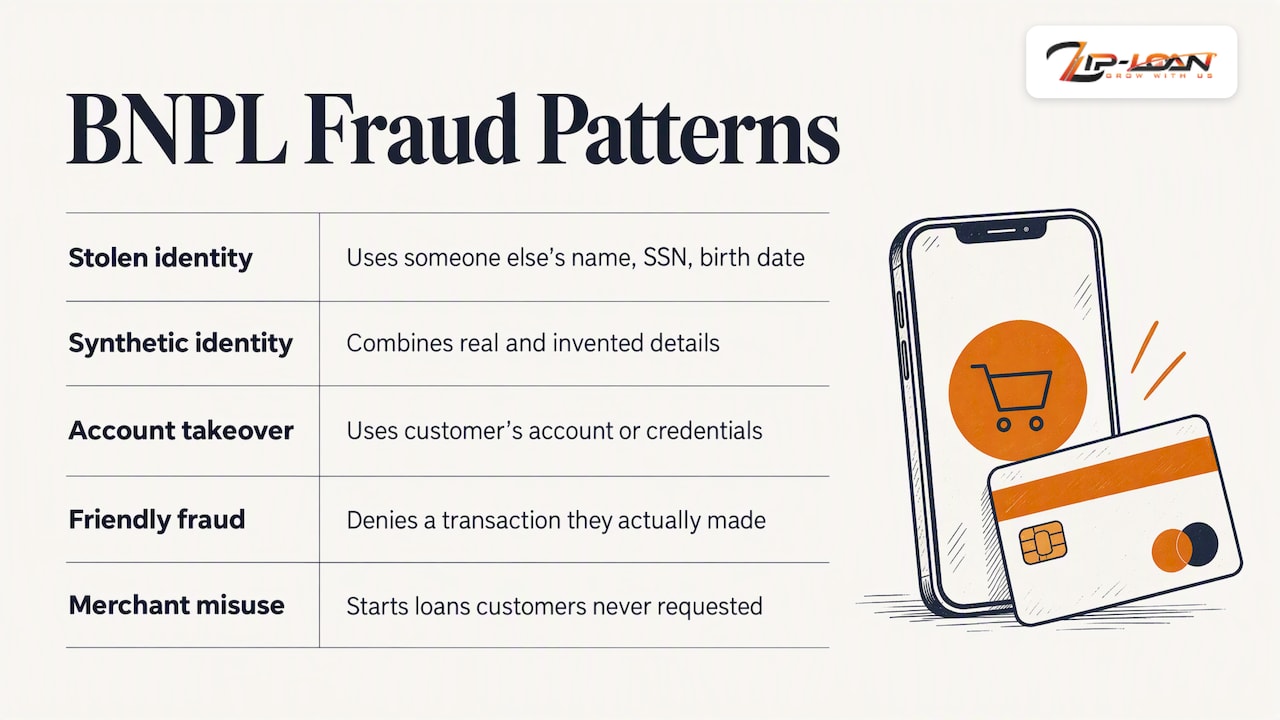
BNPL is attractive to fraudsters for the same reason it is attractive to customers: approval is fast and friction is low. A short application, a soft-pull pre-qualification and instant approval at checkout leave a narrow window in which to decide whether the person on the other end is real, present and willing. Fraud tends to cluster in five patterns.
Stolen identity. A criminal applies using someone else’s name, Social Security number and date of birth, then buys goods that can be resold. The Federal Trade Commission’s 2020 Consumer Sentinel data book counted 1.4 million identity theft reports, 29.4% of all reports that year. The figure is dated, but it shows the scale of the raw material available to applicants who are not who they claim to be.
Synthetic identity. Real and invented details are combined, for example a genuine SSN with a fabricated name and address. These profiles can pass basic checks, build a small repayment history and then “bust out” on a larger purchase. They are harder to spot because no victim complains.
Account takeover. A fraudster gains access to an existing customer’s financing account or credentials and draws on available credit. The loss lands on the lender and often on the merchant who shipped the goods.
Friendly fraud. A customer claims they did not authorize a transaction they actually made, leaving the merchant or provider to absorb the loss. Without a record of consent, you have little to argue with.
Merchant-side misuse. An employee, contractor or reseller starts loans a customer never requested, often to hit a sales target or to pull funds forward. This is the pattern regulators have targeted most directly, and it is the one merchants most often underestimate.
Why your liability does not end at the provider
Many merchants assume the financing partner carries the fraud risk. In practice, risk is shared by contract, and regulators look at everyone who made the loan possible.
In 2021 the CFPB took action against GreenSky for enabling contractors and other merchants to take out loans on behalf of thousands of consumers who did not request or authorize them. The order mandated refunds and loan cancellations of up to $9 million. The lesson for merchants is practical: when a loan can be initiated at your counter, an authorization failure becomes your reputational problem and, through your provider’s contract terms, potentially your financial one.
The CFPB’s 2025 order against Cash App’s operator, Block, points the same way for platforms generally. The Bureau said the company allowed fraud to proliferate and closed reported fraud cases without a legally required investigation. That case concerned payments under the Electronic Fund Transfer Act, not BNPL, but the expectation it illustrates is transferable: platforms and the businesses around them are expected to prevent, detect and limit fraud, not to shift disputes onto someone else.
Layer 1: Verify the identity before you extend the offer
Identity verification is the first barrier. Build it so that it adds friction only when risk is higher.
- Match the basics. Name, address, date of birth and phone number should be consistent with each other and with the data your provider returns. Mismatches between the shipping address and the billing or applicant address deserve a second look.
- Use document or database verification for larger tickets. A driver’s license scan with a selfie match, or a knowledge-based check against records, belongs on higher-value purchases rather than every $80 transaction.
- Check contact data age and type. Brand-new email addresses, recently created phone numbers and prepaid VoIP lines are common in fraudulent applications. None is proof on its own, but together they raise a risk score.
- Do not treat soft-pull pre-qualification as identity proof. A soft pull tells you about credit capacity, not about whether the applicant is the person the file belongs to.
The FFIEC’s guidance on customer remote access to financial services calls for layered security: fraud detection and monitoring that consider customer behavior, out-of-band verification for sensitive transactions, and clearly defined roles and responsibilities when third-party solutions are involved. It is written for financial institutions, but it is a sound template for any merchant embedding financing in its checkout.
Layer 2: Capture explicit, documented authorization
If you do only one thing after reading this guide, do this. The enforcement history above is a history of loans that customers say they never authorized.
Strong authorization has four features:
- The customer, not the employee, completes the consent step. A text or email link sent to the customer’s own phone, or a QR code scanned on their device, keeps the keyboard out of staff hands.
- Multi-factor confirmation. A one-time code delivered to the number on the application confirms the applicant controls that device. This is the out-of-band verification the FFIEC describes.
- The terms are shown before acceptance. Amounts, payment schedule and any fees should be on screen when the customer agrees, with the acceptance time-stamped.
- You keep the record. Store the timestamp, device information and the confirmation event so that you can answer a dispute in minutes rather than weeks.
For in-person service businesses such as auto repair, dental offices or home improvement contractors, add a simple rule: no financing application is started on a customer’s behalf without the customer physically or digitally present. Our guide to auto repair payment plans shows how that works at a service counter.
Layer 3: Read the signals around the application
Standard authentication is only the start. The FFIEC’s operational risk guidance for retail payment systems notes that operational risk arises from fraud by both employees and external sources, and the practical response is automated monitoring that works before a transaction is finalized, because manual review typically happens too late. Three signal families do most of the work:
- Device fingerprinting. Does this browser or phone match one previously associated with this customer? Does the same device appear on a dozen different applications?
- Geolocation. A customer who lives in Ohio applying from an IP address in another country, or through a proxy, is a mismatch worth a step-up check.
- Behavioral analytics. Pasting rather than typing an SSN, unusually fast form completion, or a purchase far outside a customer’s historical pattern can flag scripted or coached applications.
A practical way to use these is a three-tier response. Low-risk applications proceed without added friction. Medium-risk ones trigger a one-time code or document check. High-risk ones go to manual review or are declined with a clear path to appeal. The aim is to protect approval rates for genuine customers, since over-blocking costs sales just as fraud costs margin.
Watch the product category as well. High-resale items such as jewelry, electronics and tires attract organized fraud rings, while services such as healthcare or repairs are less resalable and more exposed to authorization disputes. If you work in healthcare, our BNPL for healthcare providers guide covers the CFPB and CMS considerations specific to patient financing.
Layer 4: Monitor your own staff and partners
Fraud prevention is often framed as keeping outsiders out. Lending-related risk guidance points inward as well: risk frequently originates with third parties such as contractors or resellers who exploit a financing platform. The FFIEC’s BSA/AML manual section on lending activities is a useful reminder that lending channels attract misuse from several directions, and that due diligence on those connected to the channel matters.
For a merchant with multiple locations, salespeople or subcontractors, put these monitors in place:
| Red flag | What it may indicate | First response |
|---|---|---|
| Sudden spike in financed volume at one location or rep | Pressure on sales targets, unauthorized applications | Pull a sample of applications and call the customers |
| Early payoffs soon after funding | Synthetic identities or cycled loans | Review the applicant files and funding trail |
| Rising chargebacks or disputes | Friendly fraud, weak authorization records | Audit consent logs for the affected transactions |
| Many applications from one device or address | Coached applicants, fraud ring | Block the device and escalate to your provider |
| Repeated declines followed by approvals on altered details | Application tampering | Require document verification |
The same discipline applies to financing stacked on other debt. If your customers are small businesses applying for financing, a reference such as loan stacking enforcement checks shows how multiple concurrent obligations can build up unnoticed, which is one reason to confirm what an applicant already owes before approving a larger program.
Also be careful with the data you collect. The FTC has warned that fraudsters buy high-quality leads, including loan applications with Social Security numbers and bank account details, to run phantom debt scams and make unauthorized withdrawals. Limit who in your business can see application data, avoid emailing it, and share it only with vendors you have vetted.
What the 2026 rules mean for your fraud program
The regulatory picture is split, and it is worth knowing which part applies to you.
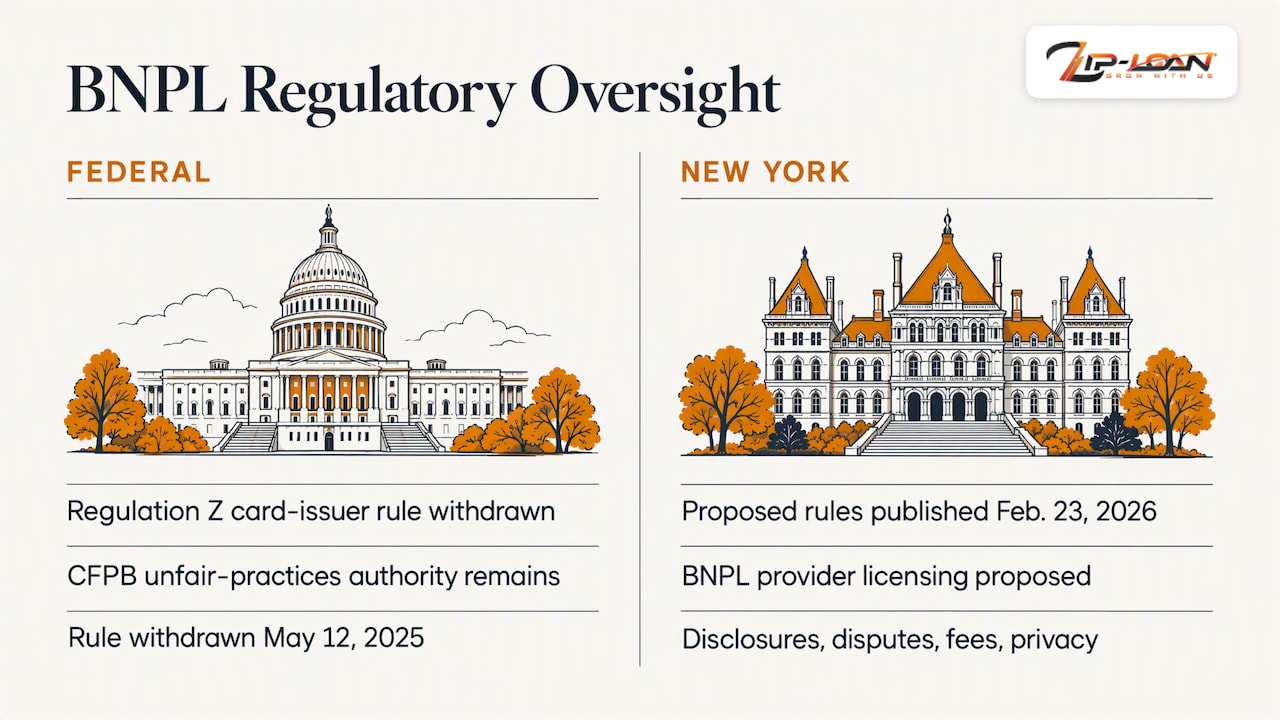
Federal. The CFPB issued an interpretive rule in 2024 that would have treated certain BNPL lenders as card issuers under Regulation Z. The Bureau says on its BNPL resource page that it withdrew that rule on May 12, 2025. That removes one set of federal dispute and refund requirements, but it does not remove the Bureau’s authority over unfair or deceptive practices, which is the basis on which cases like GreenSky were brought.
State. New York is the clearest example of where oversight is heading. On February 23, 2026, the state’s Department of Financial Services published proposed rules implementing a law that creates a licensing and supervision framework for BNPL providers, with required disclosures, dispute resolution standards, limits on fees and data privacy protections. The rules were proposed and subject to a comment period at that time, so check the DFS site for their current status before relying on specifics. If you sell to New York residents, ask your financing provider how it is preparing.
The practical conclusion is that good dispute handling and consent records serve you under any regime. For a broader view of how the environment is shifting, see our BNPL trends for 2026 and retail credit trends pages.
How to evaluate a financing partner’s fraud controls
Do not assume your provider catches everything. Ask these questions before you sign, and again at each contract renewal:
- Who bears the loss for identity fraud, friendly fraud and unauthorized merchant-initiated loans, and where does the contract say so?
- What identity verification is run on every application, and what step-ups are triggered by risk?
- How is customer consent captured, and can you export the record for a dispute?
- Does the platform monitor merchant-level patterns such as volume spikes and early payoffs, and will it alert you?
- If the platform uses multiple lenders, how are applications routed, and does each lender apply its own fraud checks?
- How are disputes escalated, and what are the response times?
This last point matters for programs that serve every credit profile. Offering financing without hard credit barriers is not the same as offering it without verification. Our pieces on how to offer no credit check financing and the realities of no credit check financing explain how to widen approval while keeping identity and authorization controls intact. For a fuller risk framework, read our customer financing risk management strategies.
Our perspective: fraud control is a revenue decision
Merchants often treat fraud prevention as a cost center and approval rates as the growth lever. We see them as the same lever. A checkout that approves a wide range of credit profiles only stays profitable if the approvals are real, the customers consented, and the funding is not reversed three months later.
What we emphasize with merchants is sequencing. Start with consent, because it is cheap, it protects you from the type of case regulators have actually prosecuted, and it also improves the customer experience by making terms clear. Add identity checks proportionate to ticket size next. Then use the volume of data your financing program produces to watch your own locations and teams, since internal misuse is the risk merchants most often do not see until a customer calls.
We also encourage merchants not to equate a multi-lender structure with weaker controls. A waterfall that routes an application to the next lender after a decline can raise approval rates, but only if each step carries its own verification and the merchant keeps one clear record of consent. When you evaluate any program, ours included, ask to see how the application is verified, how consent is stored and what you will be alerted to. That is the conversation that protects your business and your customers.
— Joe
Put the controls into your checkout
If you are building or tightening a customer financing program, ZipLoan gives you single-lender or multi-lender financing for all credit types, integrated with POS and ecommerce systems, with a streamlined application and customized payment programs. You can see how offering payment plans for customers works, or explore our multi-lender financing options if you want broader approval coverage with consistent oversight.
A 30-day implementation plan
- Week 1: Document your current application flow. Mark every point where an employee, not the customer, enters or confirms data.
- Week 2: Move consent to the customer’s device with a one-time code and a time-stamped record. Write the rule that no application is started without the customer present.
- Week 3: Define risk tiers by ticket size and product category, and set the step-up check for each.
- Week 4: Build a monthly report by location and rep showing volume, early payoffs and disputes, and assign someone to review it.
Afterward, test the process: have a manager attempt an application with mismatched details and confirm the flow stops it.
FAQ
What is the most common type of BNPL fraud for merchants?
Identity-based fraud, using stolen or synthetic details, is the pattern most often discussed, followed by friendly fraud, where a customer disowns a purchase. Which one hurts you most depends on what you sell: resalable goods draw identity fraud, while services draw authorization disputes. Review your own dispute history to see which pattern shows up first.
Does my BNPL provider cover fraud losses?
Not automatically. Loss allocation is set by your contract, and it can differ for identity fraud, disputes and loans started without customer authorization. Ask for the terms in writing and confirm what your consent records need to show.
Can someone take out a financing loan in a customer’s name?
Yes, if the identity checks are weak. A customer who suspects it should review their reports at AnnualCreditReport.com, which lists warning signs such as denials of credit they did not apply for, and can place a free fraud alert with one of the three credit bureaus. A fraud alert asks businesses to verify identity before opening new accounts.
Is BNPL regulated at the federal level in 2026?
The CFPB withdrew its 2024 BNPL interpretive rule in May 2025, so the card-issuer treatment under Regulation Z no longer applies. Federal enforcement against unfair or deceptive practices remains, and states such as New York are building their own licensing and consumer protection frameworks. Check the rules in each state where you sell.
How can I reduce fraud without hurting approval rates?
Apply friction in proportion to risk. Let low-risk applications pass, use one-time codes for medium-risk ones, and reserve document checks and manual review for the highest-risk cases. Capturing consent on the customer’s own device costs almost nothing in conversion and removes the largest legal exposure.
Sources
- FTC Consumer Sentinel Network Data Book 2020
- CFPB action against GreenSky
- CFPB order against the operator of Cash App
- FFIEC: Customer Remote Access to Financial Services
- FFIEC: Operational Risk in Retail Payment Systems
- FFIEC BSA/AML Manual: Lending Activities
- FTC: Follow the Lead
- CFPB: Buy Now, Pay Later products
- New York DFS: proposed BNPL regulation announcement
- AnnualCreditReport.com: Identity theft basics
Recommended
- BNPL for Healthcare Providers: Track Metrics, Navigate CFPB and CMS
- BNPL Trends 2026: What They Mean for Merchants
- Buy Now Pay Later for Business: 2026 Merchant Growth Guide
Disclaimer: This article is provided by Zip Loan (Touch N Buy LLC d/b/a Zip Loan) for general informational and educational purposes only and does not constitute financial, legal, or professional advice. While we strive for accuracy, information may be incomplete, outdated, or subject to change without notice. Financing programs, rates, terms, and approvals vary by lender and applicant and are not guaranteed. Zip Loan makes no warranties regarding the information provided and, to the fullest ext