

Clover financing means two different things, and mixing them up leads to bad decisions. One is customer financing: buy now, pay later (BNPL) and patient or consumer credit that your shoppers use at your Clover checkout, such as Klarna or CareCredit. The other is merchant funding: Clover Capital, an advance your business receives against future card sales. This guide covers both, shows what each one costs you, and explains where a multi-lender platform like ours fits when Clover’s built-in options do not approve every buyer.
TL;DR
- Clover’s built-in customer financing is delivered through partners. Klarna covers retail installments and CareCredit covers health and wellness providers, and both run inside the Clover environment.
- With BNPL such as Klarna, you are paid the purchase amount at settlement, minus standard transaction fees, and the financing provider carries the credit and fraud risk.
- Clover Capital is a different product. It is an advance based on future sales, repaid as a percentage of daily sales, and it is not a loan.
- A single-provider setup approves only the customers that provider approves. If you serve mixed credit profiles, a multi-lender cascade can capture the buyers who are declined first.
Table of Contents
- What “Clover financing” actually covers
- Customer financing options you can connect to Clover
- How the money flows when a customer finances at checkout
- Setting up financing on a Clover device
- What the customer experiences
- Where a single financing app falls short
- Choosing by ticket size and industry
- Our perspective
- Add multi-lender coverage to your checkout
- Costs and terms to check before you enable anything
- FAQ
- Sources
What “Clover financing” actually covers
Search results for this topic blend three categories, so separate them before comparing anything.
- Customer financing at checkout. Your customer splits or finances a purchase and you receive payment. Klarna and CareCredit are the Clover-connected examples.
- Merchant funding. Clover Capital gives your business working capital. Your customer never sees it.
- Processing and ownership. Clover is the point-of-sale platform owned by Fiserv, which matters because financing partners connect to it through Fiserv’s ecosystem, as the Klarna and Clover partnership coverage describes.
If you are a retailer, auto shop, clinic or contractor trying to help customers afford larger tickets, category one is your focus. Category two only matters if your own cash flow is the constraint.
Customer financing options you can connect to Clover
Klarna for retail and service checkouts
In April 2025, Klarna and Fiserv-owned Clover announced a partnership to bring Klarna’s installment payments to U.S. merchants, with an initial rollout to 100,000 locations. Clover describes the experience in-store as simple: shoppers scan a QR code on the Clover device to use Klarna, and the merchant is paid upfront and in full on the standard Clover payout schedule.
Clover’s own merchant messaging says Klarna lets customers split a purchase into four interest-free payments, and it presents the option as a way to lift sales and average order value. Treat that as a vendor claim to test against your own numbers, not a guarantee. The pay-in-four model also has a ceiling: it suits tickets in the low hundreds well, and it is a weaker fit for a $3,000 transmission rebuild or a $6,000 dental plan.
CareCredit for health and wellness providers
For medical, dental, veterinary and wellness practices, Synchrony expanded its Clover integration in January 2026. The Pay with CareCredit app is pre-installed on Clover devices and now lets staff manage the patient financing process from application to final payment inside Clover, reaching more than 40,000 health and wellness providers. The earlier launch followed the October 2021 announcement of Synchrony point-of-sale financing for Clover merchants, which highlights how long the platform has been building toward partner-delivered credit.
This is a strong fit when your patients already know CareCredit. It still leaves one question open: what happens to the patient who is declined?
Clover Capital: financing for your business, not your customer
Clover Capital is often confused with customer financing because it appears in the same search results. It is merchant funding. Clover states that Capital is not a loan but an advance of funds against future sales. The offer carries no interest rate; instead it includes a fixed additional amount, and payments are taken as a percentage of your daily sales.
Eligibility, per the same Clover page, requires that your business:
- is at least 6 months old,
- has processed with Clover or an approved reseller for at least 90 days, and
- meets a minimum processing volume of $1,000 per month for 3 months.
Because repayment follows sales, a slow week shrinks the payment and a busy week enlarges it. That flexibility has a price. A New York business-law firm’s guide to POS financing warns that effective APRs can run high and that automatic daily deductions can strain cash flow. If you take an advance, convert the fixed additional amount into an effective cost before you sign. Our explainer on what APR means for a business walks through that conversion.
How the money flows when a customer finances at checkout
The mechanics matter more than the marketing, because they decide your risk.
| Question | BNPL through Clover (Klarna) | Clover Capital |
|---|---|---|
| Who is the borrower? | Your customer | Your business |
| When do you get paid? | Purchase amount at settlement, minus standard transaction fees | Funds advanced to you up front |
| Who carries credit and fraud risk? | The financing provider | You, through repayment from sales |
| How is it repaid? | Customer pays the provider in installments | Percentage of daily sales |
| Interest rate | Customer: interest-free in pay-in-four | None, but a fixed additional amount applies |
The first two rows describe what Clover says about merchant settlement with BNPL: you receive the full purchase amount at settlement, less normal fees, while the provider assumes the credit and fraud risks. Clover also argues that integrated financing frees you from manually tracking invoices or chasing late payers. That is the central appeal of any non-recourse model: the sale is final on your books, and collections sit with the lender.
If you also sell online, the same logic applies to your web checkout. Placement and layout of the payment option influence conversion, and a practical read on Shopify checkout optimization shows how much checkout design alone can change results. For a storefront on that platform, see our guide to Shopify financing integration.
Setting up financing on a Clover device
Clover’s financing partners are delivered as apps and embedded features, so the steps follow a common pattern. Exact screens and eligibility change, so confirm each step on Clover’s and the provider’s current pages before you commit.
- Confirm your plan and eligibility. Klarna on Clover is offered to qualifying businesses, and CareCredit requires a provider relationship with Synchrony. Check your merchant account type and whether you bought through Clover directly or a reseller.
- Open the Clover App Market or your dashboard. Look for the financing app or the Klarna option. CareCredit’s app arrives pre-installed on Clover devices, per the January 2026 announcement above.
- Complete the provider’s merchant enrollment. Expect business verification and agreement to the provider’s terms and fee schedule.
- Train staff on the customer flow. For Klarna, staff present the QR code on the device. For CareCredit, staff guide the patient through application and payment on the device.
- Display the option. Put a decal at the counter, a line on estimates and a mention in your appointment confirmations. Financing that customers do not know about does not lift tickets.
- Reconcile at settlement. Compare payouts against sales so you can see the transaction fee on financed orders and track average ticket before and after.
Our own guide to setting up customer financing and the walkthrough on connecting financing to checkout cover the general sequence for any POS.
What the customer experiences
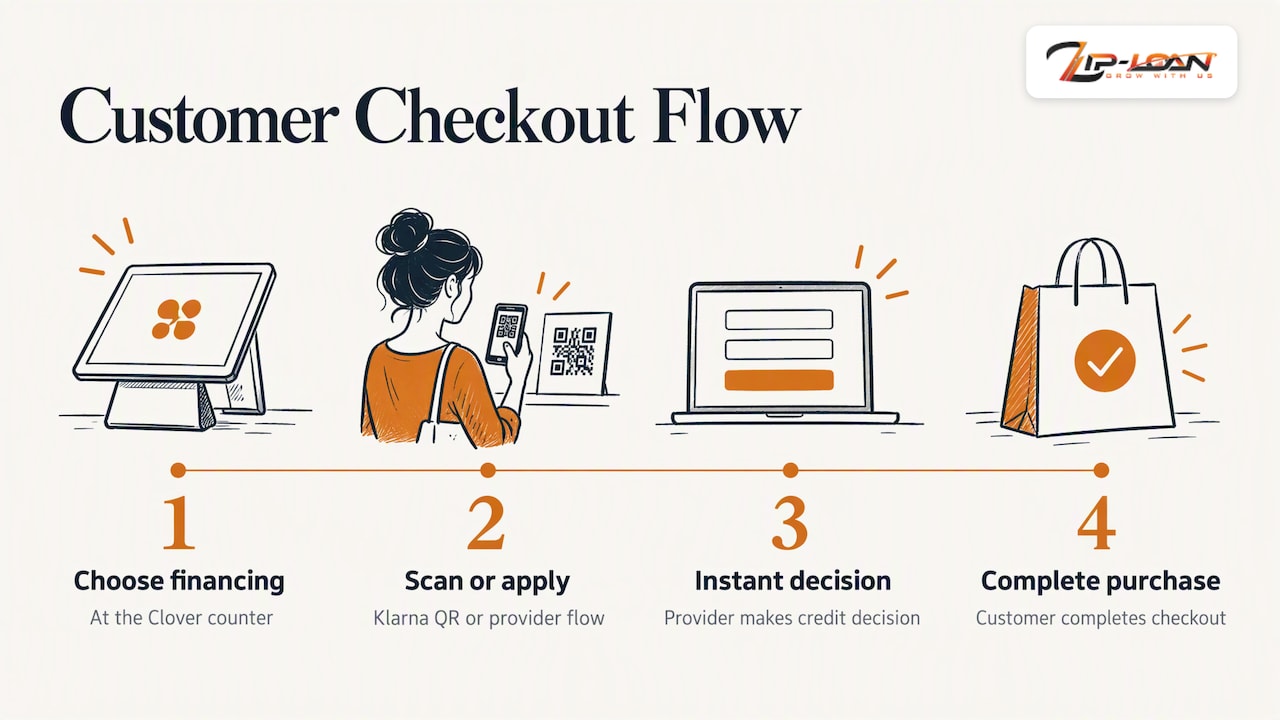
From the buyer’s side, the flow is short. At a Clover counter, the customer chooses the financing option, scans the QR code for Klarna or applies through the provider’s flow, receives an instant decision, and completes the purchase. The merchant does not underwrite anything. The provider performs the credit decision, which is exactly why approval rates differ between providers.
One practical point for your front-of-house team: the customer should hear the repayment terms from the provider, not from your staff. Describe what the product is, and let the provider’s disclosures cover rates, fees and schedules.
Where a single financing app falls short
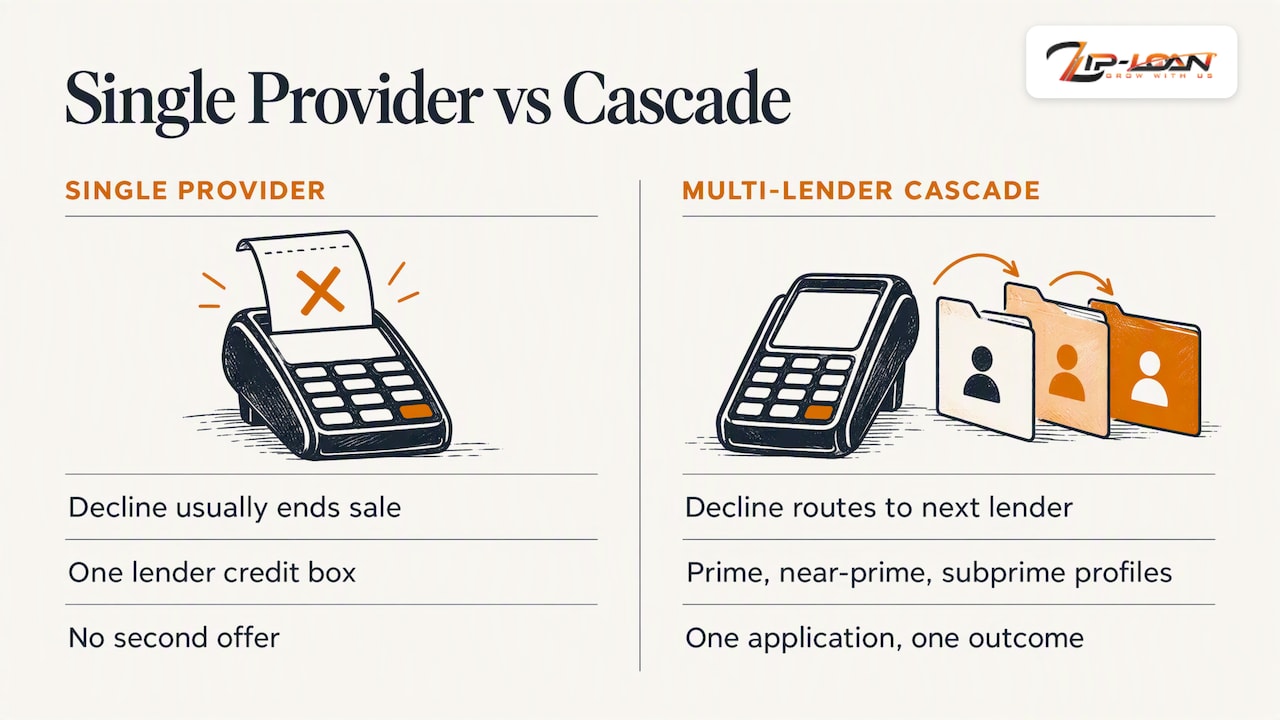
A single-provider option works well until a customer is declined. Every lender has its own credit box. A pay-in-four product screens for short-term repayment ability on small tickets, and a healthcare card has its own score thresholds. When a shopper fails one screen, the sale usually ends there, because staff have no second option to offer.
This is the gap a multi-lender approach addresses. In a waterfall cascade, an application goes to the first lender, and if it is declined, the platform automatically routes it to the next lender configured for a different credit profile, including prime, near-prime and subprime consumers. You see one application and one outcome, rather than a stack of separate lender logins.
To be fair to Clover’s built-in options: for customers who qualify, they are convenient and quick to turn on. The question is whether they alone cover your customer base. Review your recent declined or abandoned high-ticket sales. If that number is meaningful, the next step is layering coverage, not replacing what works. Our comparison of Klarna alternatives for merchants lays out the criteria.
Choosing by ticket size and industry
| Your business | Typical ticket | What to prioritize |
|---|---|---|
| Boutique, gift or accessory retail | Under $500 | Pay-in-four convenience, fast QR checkout |
| Auto repair and tire shops | $500 to $5,000 | Longer terms, approvals for fair and poor credit |
| Dental, medical, veterinary | $500 to $10,000 | Healthcare-specific credit plus a fallback lender |
| Furniture, mattresses, jewelry | $1,000 and up | Installment and lease-to-own options in one flow |
| Home improvement and contractors | $2,000 and up | Project-sized credit lines, not pay-in-four |
The ranges are illustrative planning bands, not market statistics. Lease-to-own and installment credit behave differently for the customer and the merchant, so read our lease to own vs. installment credit guide before choosing. Auto shops can start with our auto repair payment plans guide.
Our perspective
We talk with merchants about financing every week, and the same pattern repeats: owners treat “turn on financing” as a one-time checkbox, then wonder why only a fraction of customers use it. The checkbox is the easy part. Results come from three decisions that sit around it.
First, coverage. If one lender approves only part of your customer base, the rest of your high-ticket traffic still walks out. A multi-lender cascade, with prime options first and subprime-capable options behind them, protects the sale without making your staff choose between lenders. Second, risk structure. Non-recourse funding, where the lender assumes the credit decision and you are paid at settlement, keeps your balance sheet clear of collections. Third, presentation. Soft-pull pre-qualification lets customers see whether they qualify before a hard inquiry, which lowers hesitation at the counter.
We would also say plainly that Clover’s own financing partners are good tools for the customers they approve, and that Clover Capital solves a different problem than customer financing. Our role is to extend your reach to buyers a single lender cannot approve, across installment loans, lease options, no credit check programs and private label credit, with custom payment programs for your ticket sizes. Whatever you choose, measure approval rate, financed share of revenue and average ticket for ninety days, then adjust.
— Joe
Add multi-lender coverage to your checkout
Zip-Loan is a platform for merchants that want to offer third-party consumer financing at checkout for all credit profiles. It connects to POS and ecommerce systems, supports single-lender or multi-lender programs, and serves sectors such as automotive, healthcare, home improvement, furniture and jewelry. Customers rate us 4.9 out of 5 across more than 95 reviews.
If you want to see what a layered program looks like for your business, start with our page on how to offer payment plans for customers.
Prefer to research first? Our retail financing options guide compares the main models side by side.
Costs and terms to check before you enable anything
Use this list with every provider, including us.
- Merchant fee per financed transaction. Ask for the rate by product and term. Clover says BNPL pays you the purchase amount minus standard transaction fees, so find out what that fee is on financed orders.
- Funding timing. Confirm whether you are paid at settlement on your normal payout schedule or on a different cycle.
- Recourse. Ask in writing who bears the loss on non-payment and fraud.
- Approval coverage. Ask for approval rates by credit tier and by ticket size, not a headline number.
- Customer costs. Pay-in-four may be interest-free, but longer products carry an APR. Make sure staff do not misstate terms.
- Contract exit. Check minimums, term length and what happens to open customer accounts if you leave.
- Reporting. You need financed volume, declines and fees reconciled to your Clover sales data.
The broader trend context is in our point of sale financing trend analysis, and our benefits of customer financing guide covers the revenue case.
FAQ
How does Clover financing work?
For customers, Clover connects to financing partners such as Klarna and CareCredit, which handle the application, the credit decision and repayment. For you, the purchase amount arrives at settlement minus standard transaction fees, and the provider carries the credit and fraud risk. Clover Capital is separate: it is an advance to your business, not customer financing.
Can you get loans through Clover?
Not exactly. Clover Capital is described by Clover as an advance of funds based on future sales, not a loan. It has no interest rate, includes a fixed additional amount, and is repaid as a percentage of daily sales. Eligibility includes 6 months in business and at least $1,000 a month in processing for 3 months.
Does Clover use Fiserv?
Yes. Clover is owned by Fiserv, and press coverage of the Klarna partnership refers to it as Fiserv’s Clover. Financing partners such as Klarna and Synchrony integrate with Clover as third parties on that platform.
Can I offer more than one financing provider on Clover?
Built-in apps each serve their own lender, so a second option usually means a separate integration or a platform that routes applications across several lenders. Ask any provider how its flow appears to staff at the counter and whether declined applicants can be passed on automatically.
Sources
- Klarna partners with Fiserv’s Clover, Payments Dive
- Accept Payments, Clover
- Buy Now Pay Later: Why merchants need it, Clover Blog
- Buy Now, Pay Later: How It Drives Retail Growth, Clover Blog
- Clover Capital, Clover
- SYF Enhances Patient Financing Options With Clover Integration, Yahoo Finance
- POS Financing: What Small Businesses Must Know
- Shopify Checkout Optimization, Dogtooth
Recommended
- POS Financing Integration: How to Connect Financing to Checkout
- Square Financing Integration: Your Options for Customer Financing
- Shopify Financing Integration: Offer Customer Financing
- 2026 Merchant Guide to Setting Up Customer Financing
Disclaimer: This article is provided by Zip Loan (Touch N Buy LLC d/b/a Zip Loan) for general informational and educational purposes only and does not constitute financial, legal, or professional advice. While we strive for accuracy, information may be incomplete, outdated, or subject to change without notice. Financing programs, rates, terms, and approvals vary by lender and applicant and are not guaranteed. Zip Loan makes no warranties regarding the information provided and, to the fullest ext