

Offering customer financing can cost your business anything from nothing to roughly what you already pay to process a credit card sale, according to Merchant Maverick’s customer financing guide. The wide range exists because fees depend on the provider, the loan product, the promotional terms you offer and the credit profile of the buyer. This guide breaks down each fee type, who ends up paying it, how it hits your margin and what to verify in a fee schedule before you sign.
TL;DR
- Most merchant-side financing costs arrive as a percentage of each financed sale, sometimes with a fixed dollar component, and many providers do not publish rates, so you have to request a written schedule.
- Promotional plans (0% interest, deferred interest) usually shift cost from the customer to you in the form of a higher merchant fee.
- Passing a fee through to the customer in the price can trigger Regulation Z disclosure problems, so structure it with your provider and counsel.
- Judge a program by net margin after fees, funding speed and refund handling, not by the headline rate alone.
- Ask for every fee in writing: discount rate, dealer fee, setup, monthly platform fee, chargeback and return terms.
Table of Contents
- The fees you can expect to see
- Who pays: you, your customer, or both
- How promotional plans change the math
- How fees affect your margin
- What to check in a fee schedule
- Fees by industry
- Our perspective on financing fees
- Offer financing without guessing at the cost
- FAQ
- Sources
The fees you can expect to see
Customer financing fees fall into a handful of categories. Not every provider uses all of them, and the mix is what separates a cheap-looking program from an inexpensive one.
| Fee type | How it is usually charged | What drives it |
|---|---|---|
| Merchant discount or dealer fee | Percentage of the financed amount, a fixed dollar amount, or both | Loan product, promo length, credit tier of the buyer |
| Setup or onboarding | One-time, if charged at all | Integration work, POS or ecommerce connection |
| Platform or software fee | Monthly or annual | Software-based and in-house models |
| Transaction fee | Per funded loan | Provider pricing model |
| Chargeback, return or reversal costs | Per event, or a reduced payout | Recourse terms and your refund policy |
Merchant Maverick’s research is candid that many providers keep rates private, so the first practical step is simply to ask. One widely shared industry write-up on LinkedIn puts a typical discount rate at 3 to 5 percent of each financed sale. Treat that as a conversation starter, not a quote: subprime-friendly products and long promotional terms can cost more.
Discount rates and dealer fees
The discount rate (often called a dealer fee in home improvement and solar) is the core cost. The lender funds the purchase, pays you the amount minus the fee, and collects from the customer over time. OpenSolar’s U.S. support documentation shows the structure well: a dealer fee can be configured as a percentage, a fixed dollar amount or both, and the business can absorb it, pass some or all of it into pricing, or accept a smaller margin.
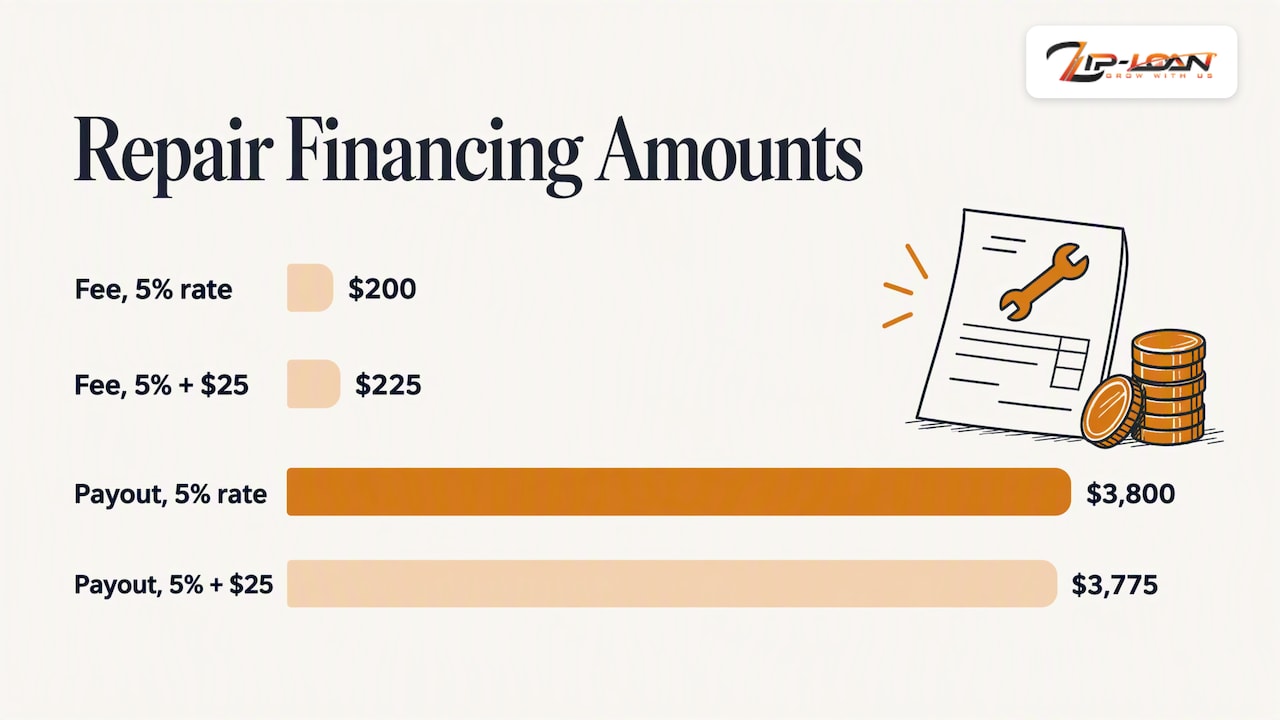
A quick example with illustrative numbers, not a ZipLoan quote: on a $4,000 financed repair with a 5% discount rate, you receive $3,800 and the provider keeps $200. If the same job carried a 5% fee plus a $25 fixed fee, you would receive $3,775.
Setup, platform and transaction charges
Some models replace per-sale percentages with software fees. Small Loan Software, for instance, advertises in-house financing software at $199 to $499 per month. That is a vendor’s own claim about its own product, and an in-house model means you carry the credit risk and collections yourself, so it is a different decision from using a third-party lender. Whatever the model, confirm in writing whether there is any setup fee, minimum monthly charge or per-loan transaction fee, and what each covers.
Chargebacks, returns and funding timing
Fees are not only the percentage you see on the first page. Merchant Maverick notes that third-party financing can deliver fast funding but may charge a service fee or reduce margins, and that chargeback and return policies also affect the bottom line. Ask what happens to the fee when a customer cancels or returns an item: is it refunded in full, partially, or kept? Ask also whether funding is non-recourse, meaning the lender carries the default risk once the loan is approved and funded, or whether you can be asked to buy back a loan.
Who pays: you, your customer, or both
In a typical third-party program, the merchant pays the discount or dealer fee and the customer pays the interest and any loan charges to the lender. Those are two separate pockets, and the offer you choose to make moves cost between them.
- Standard installment loans with interest. The customer pays interest over the term. Your fee tends to be lower because the lender earns on the loan.
- Promotional plans (for example 0% for 12 months). The lender earns less from the customer, so it typically charges you more up front to make the economics work.
- Lease-to-own and no credit check programs. Pricing to the customer is structured differently, and the merchant fee reflects the higher risk profile of the buyer pool. See our lease to own guide for small business customers for how these programs work.
The exact split differs by provider and product, so rely on the written schedule rather than assumptions.
Absorb the fee or build it into the price?
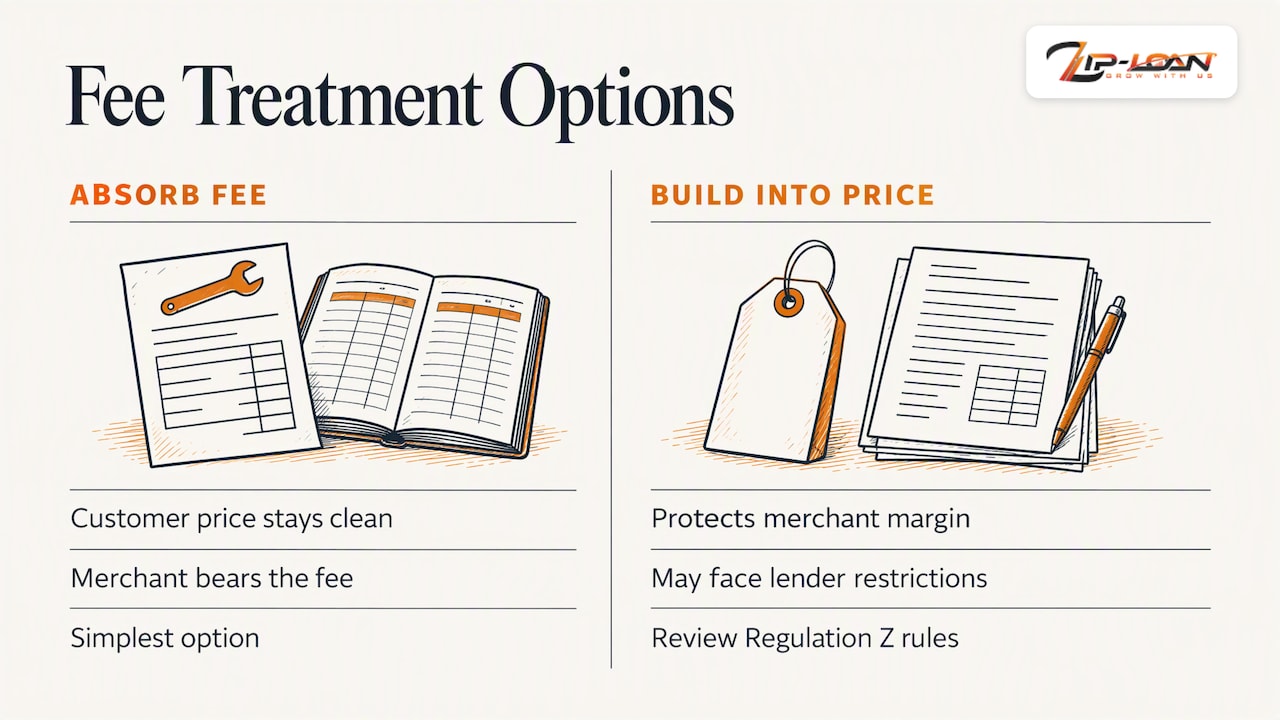
Absorbing the fee is the simplest option and keeps the customer’s price clean. Building it into pricing protects your margin, but it is where merchants get into trouble. The Consumer Financial Protection Bureau found in a consent order that inflated goods prices concealed the true cost of credit, producing inaccurate finance-charge and APR disclosures that violated Regulation Z. OpenSolar’s documentation likewise cautions that pass-through treatment must comply with Regulation Z and the lender’s rules.
If you are considering a different price for financed buyers, review it with your lender agreement and a qualified attorney before it goes live. Many lender contracts restrict or prohibit it.
How promotional plans change the math
Promotional financing is one of the strongest conversion tools, and one of the most misunderstood cost levers. There are two common forms:
- True 0% interest. No interest accrues during the promotional window.
- Deferred interest. Interest accrues from the purchase date and is waived only if the balance is paid in full by the end of the promotion. The CFPB explains that deferred interest offers differ from zero interest offers, and the “if” in the offer wording is what to look for.
For you, the consequence is practical. A longer promotional window usually means a higher merchant fee, and the customer-facing language must be accurate, because your staff will be the ones explaining it at the counter. A customer who feels surprised by retroactive interest blames the store that offered it.
Before running a promotion, model it:
- Your average financed ticket and the fee at each promo length.
- The lift in conversion or order value you expect, which you can validate against the metrics worth tracking in a financing program.
- Whether a modest increase in average order value covers the extra fee. Our guide on increasing AOV for retailers covers that side.
How fees affect your margin
A fee is a cost of sale, and it should be judged against the sale it creates. Sparklight advises businesses to review past sales to forecast how financing-company fees could affect revenue. That is the right method, and it can be done in an afternoon.
A simple margin test
- Pull 12 months of sales and identify tickets above the level where customers hesitate or abandon.
- Estimate the share that would be financed. Start conservatively.
- Multiply financed volume by the quoted fee to get the annual cost.
- Compare it with the gross margin on sales you would not otherwise have closed, plus cash you collect sooner because the lender funds you rather than the customer paying in installments to you.
If the program converts even a modest number of declined or deferred purchases, the fee is often smaller than the margin on the added sale. If it only moves existing cash buyers onto a financed ticket, it is a pure cost. Know which case you are in.
The cost of rejection
A low-fee provider that approves only prime borrowers can be more expensive in practice than a higher-fee program that approves more buyers. This is why multi-lender setups matter: an application that is declined by one lender can cascade to the next rather than ending the sale. Our multi-lender financing options page explains how that routing works.
What to check in a fee schedule
The U.S. regulatory record shows why precision matters. In a stipulated order, the FTC barred the defendants from misrepresenting credit terms, including fees, interest rates, APRs, finance charges and payment terms. Your exposure as a merchant depends on how you describe a program to customers, so you want a provider whose disclosures are clear and whose materials you can repeat accurately.
Request these items before you commit:
- Complete rate sheet by product, promo length and credit tier, with the fee expressed as a percentage, a fixed amount or both.
- Setup, monthly and per-transaction charges, including minimums.
- Funding timeline and how it is paid (ACH, timing after delivery or completion).
- Recourse terms: whether defaults, fraud or buybacks can come back to you.
- Return and cancellation treatment of the fee.
- Contract term, termination rights and any early-exit charges.
- Customer-facing disclosures and approved language for staff and marketing.
- Integration scope with your POS or ecommerce platform, and who pays for it.
Merchant Maverick recommends comparing several providers because most do not share fee or contract details upfront. Put the quotes side by side on net proceeds per $1,000 financed, not on the headline rate. Our walkthrough on how to choose a consumer financing partner gives a fuller scorecard.
If you also keep customer cards on file for deposits or balances, separate that payments-side cost from the financing fee, and review the rules in this overview of card on file for merchants so the two do not blur together in your cost model.
Fees by industry
The fee conversation changes with the ticket size and buyer profile.
- Automotive repair: Tickets are unplanned and often large relative to the customer’s cash on hand, so approval breadth matters as much as the fee.
- Healthcare and dental: Patient balances and elective procedures call for plans that fit a treatment schedule. See our medical program information.
- Home improvement and contractors: Project values are high and dealer fees compound quickly across multiple jobs, so confirm fee tiers before bidding.
- Furniture and jewelry: Promotional offers are common and competitive, which pushes merchant fees up with longer terms.
We cover the full range on our industries we serve page.
Our perspective on financing fees
We see merchants make the same mistake in both directions. Some choose the lowest quoted percentage and discover that a narrow approval box leaves the customers who most need financing unserved, so the program quietly produces few funded sales. Others accept a high fee on a long promotion without modeling whether the added ticket size covers it.
Our view is that a fee is only meaningful next to approval rates, funding speed and the terms attached to it. That is why ZipLoan is built around financing for all credit types, offered through single-lender or multi-lender programs, with custom payment programs that you can shape to your ticket sizes and customers. A merchant who understands the fee structure can choose promotions deliberately instead of defensively.
Our advice is simple: ask for the schedule in writing, run your own numbers on 12 months of sales, and treat any answer of “it depends” as a prompt for a specific figure.
— Joe
Offer financing without guessing at the cost
ZipLoan gives retailers, auto shops, healthcare practices and contractors a platform for third-party consumer financing at checkout, with installment loans, lease options, no credit check financing and private label credit, integrated with POS and ecommerce systems. If you want to see how a program would fit your sales, start with our retail financing options guide or visit ZipLoan to talk through pricing for your business.
FAQ
How much does it cost a business to offer customer financing?
It ranges from no fee to about the cost of a credit card processing fee, depending on the provider and product, according to Merchant Maverick. Many providers do not publish rates, so you need to request a written quote for your products and volumes.
Do customers pay the financing fee?
Usually the merchant pays the discount or dealer fee and the customer pays interest and loan charges to the lender. A merchant can try to recover the fee through pricing, but that must comply with Regulation Z and the lender’s rules, so check with your provider and counsel first.
Why are 0% promotional plans more expensive for merchants?
The lender earns little or no interest from the customer during the promotion, so it generally recovers the difference through a higher fee charged to you. Model the extra fee against the added sales the offer is expected to produce.
What should I compare besides the fee percentage?
Compare approval breadth, funding speed, recourse terms, return and chargeback handling, setup and monthly charges, and contract length. Net proceeds per $1,000 financed is the cleanest single comparison.
Can a small business afford customer financing?
Often yes, because many programs charge only per financed sale rather than a flat monthly fee. Our small business consumer financing buying guide walks through the options.
Sources
- Customer Financing Programs Guide, Merchant Maverick
- How Dealer Fees are Included and Calculated for Financed Options, OpenSolar
- CFPB consent order, Rome Finance (2014)
- FTC stipulated order for permanent injunction
- How to understand special promotional financing offers, CFPB
- What to Consider Before Offering Customer Financing, Sparklight
- How To Offer Financing To Customers, Small Loan Software
- How Much Does it Cost to Offer Customer/Patient Financing?, LinkedIn
- Card on file for merchants
Recommended
- Benefits of Offering Customer Financing: The 2026 Merchant Growth Guide
- Customer Financing Marketing: A Merchant’s Guide
- 2026 Merchant Guide to Setting Up Customer Financing
- Customer Financing Solutions for Business Growth
Disclaimer: This article is provided by Zip Loan (Touch N Buy LLC d/b/a Zip Loan) for general informational and educational purposes only and does not constitute financial, legal, or professional advice. While we strive for accuracy, information may be incomplete, outdated, or subject to change without notice. Financing programs, rates, terms, and approvals vary by lender and applicant and are not guaranteed. Zip Loan makes no warranties regarding the information provided and, to the fullest ext