

Financing options customers never notice can’t help them make an informed choice. That’s why marketing materials for customer financing should do more than announce that payment options are available. They should show customers where to learn more, how to apply, and what to expect next. If a poster sparks interest but the website or checkout leaves questions unanswered, the customer journey can stall.
Generic messaging can make a useful payment option feel confusing or disconnected from the purchase. This guide explains how to choose materials for key customer touchpoints, communicate financing clearly, and plan a rollout you can evaluate. In-store materials, digital banners, and personalized online portals can work together to keep the message consistent from first glance through application. Clear communication should set realistic expectations: approval depends on applicable lender criteria, and customers need straightforward information about terms and next steps.
Key Takeaways
- Match each format to the customer’s decision point, from quick in-store awareness to detailed information online.
- Use marketing materials for customer financing to guide customers toward a clear next step while setting realistic expectations about applying and approval.
- Compare each asset for audience fit, clarity, accessibility, and how easily its information can be updated.
- Roll out materials with reviewed messaging and staff guidance, then track application starts, completed applications, and customer questions.
- Zip-Loan’s banners, personalized portals, dashboard, and Touch-n-Buy point-of-sale materials can support a connected customer journey.
Why Financing Marketing Matters at the Point of Decision
Customers can’t consider a payment option they don’t know exists. Financing marketing materials are customer-facing messages and assets that explain available payment options and guide customers to the next step in their buying journey. Place a relevant message where a purchase decision is taking shape, and customers can learn about their choices without feeling pressured to buy.
The journey may begin when a customer first notices financing, continue as they compare options, and reach a decision at checkout. Follow-up information can answer questions that remain. For example, someone considering a major purchase might see financing on a store sign, then visit a page that explains how to learn about available options and apply. Awareness doesn’t guarantee a sale or approval, but it gives customers a chance to explore financing before leaving without knowing it was available.
For a brief overview of how retail financing is discussed, watch this video:
Where financing information helps customers make a decision
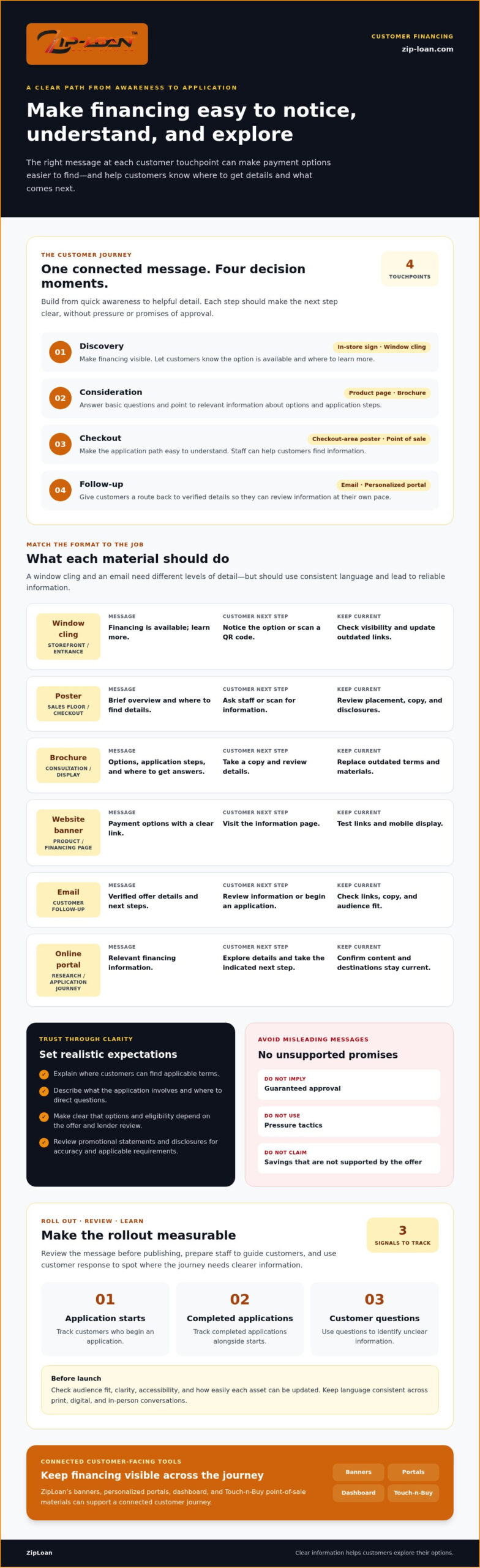
Make financing easy to spot during discovery, then provide more detail as customers move toward a decision. At the consideration stage, direct them to information that answers basic questions. At checkout, make the application path clear. In follow-up messages, include a route back to the relevant details so customers can review them at their own pace. For broader context on lending models, see Wikipedia’s overview of microfinance.
What trustworthy financing messaging should communicate
Trust starts with clarity, not a bold promise. Explain where customers can find applicable terms, what the application involves, and where to direct questions. State that available options and eligibility depend on the offer and lender review. Avoid guaranteed-approval language, pressure tactics, or savings claims that aren’t supported by the offer.
Before publishing marketing materials for customer financing, check promotional statements and disclosures for accuracy and applicable requirements. Give customers a specific next step, such as learning more or starting an application, without suggesting that every applicant will qualify. Merchants can also explore why financing can matter as they consider how payment options fit their customer journey.
Which marketing materials for customer financing fit each channel?
Choose each asset by the job it needs to do: catch attention, answer a question, or guide a customer to a next step. A window cling and an email shouldn’t carry identical detail, but they should use consistent language and point to reliable information. Matching the message to the channel makes marketing materials for customer financing a connected path rather than a collection of disconnected promotions.
| Format | Ideal touchpoint | Message | Customer action | Maintenance |
|---|---|---|---|---|
| Window cling | Storefront or entrance | Financing is available; learn more | Notice the option or scan a QR code | Check visibility and update outdated links |
| Poster | Sales floor or checkout area | Brief overview and where to find details | Ask staff or scan for information | Review placement, copy, and disclosures |
| Brochure | Consultation or product display | Options, application steps, and where to get answers | Take a copy and review details | Replace outdated terms and materials |
| Website banner | Relevant product or financing page | Payment options with a clear link | Visit the information page | Test links and mobile display |
| Customer follow-up | Verified offer details and next steps | Review information or begin an application | Check links, copy, and audience fit | |
| Personalized online portal | Customer research or application journey | Relevant financing information | Explore details and take the indicated next step | Confirm content and destinations stay current |
Printed materials for in-person conversations
Put window clings where customers can see them before reaching checkout, so financing can become part of the conversation early. Posters work well for quick awareness; brochures have more room to explain options and application steps. Keep the wording consistent across both and make the next action easy to spot. A QR code can connect a printed piece to an information page or application route, but test the destination before distributing the material.
Digital materials for research and follow-up
Use website banners to make financing visible on relevant pages, and personalized portals to present information in context. Email can direct interested customers to verified offer details or application steps. Keep digital copy readable on mobile, provide accessible text, and make every button and QR destination work as intended. For background on consumer credit terminology, consult Cornell Law School’s entry on consumer credit. Have financing claims and disclosures reviewed before publication.
Match the format to the action: clings and posters prompt awareness, brochures and portals support consideration, and banners or emails guide customers to more information or an application. To see how financing can fit into a merchant’s customer journey, explore Zip-Loan’s merchant financing options.
How to compare financing materials by audience, touchpoint, and trust
Choose an asset based on how customers will use it, not just where it can be placed. Compare each option against five questions: Who needs this information? What decision are they making? Is the message clear and accessible? Can the customer find a useful next step? How easily can you update the material if the offer changes? These questions help you choose marketing materials for customer financing that fit real customer interactions.
Separate awareness from explanation. A sign or short banner can prompt a question; a brochure, detailed page, or staff conversation can address terms and application steps. Match the call to action to the channel: invite customers to ask a team member in person, or direct them online to review details or start an application. If prequalification is offered, explain that it’s preliminary. A soft-pull prequalification doesn’t guarantee final approval or particular terms.
Choose materials for retail, contracting, and healthcare settings
In retail, make checkout messaging visible and give staff a concise explanation they can use consistently. Contractors can include financing information with estimates or discuss it during project planning, when customers are considering scope and payment options. In healthcare settings, choose discreet, patient-friendly materials that support informed conversations without making financing feel like pressure. In every setting, make the next step clear while leaving customers free to decide whether they want to learn more.
Review claims, readability, and customer confidence
Use plain language and make the core message easy to find. Check that every claim reflects the actual offer, including how promotional terms, eligibility, and approval are described. Don’t suggest that a preliminary review guarantees a final decision. For consumer credit advertising, have qualified reviewers assess which rules apply to each claim and consult the CFPB’s Federal Advertising Rules for Consumer Credit as a primary reference. Don’t assume a general guideline applies to every offer or format.
Before publishing, test the material as a customer would. Can someone understand the message at a glance, read it comfortably on a phone or printed page, and tell what to do next? Check links and application destinations, too. Consistent, readable information builds confidence; unclear claims or mismatched details can undermine it.
How to launch and measure customer-financing marketing materials
A practical rollout turns separate assets into a consistent customer experience. Start with the places customers make decisions, then prepare the message, staff, and measurement approach before anything goes live. This makes it easier to spot gaps and improve materials based on customer response rather than guesswork.
- Select touchpoints: Choose where customers should encounter financing information, such as the sales floor, website, email, or a follow-up conversation.
- Approve copy: Confirm that descriptions, eligibility language, terms, and next steps match the current offer.
- Assign distribution: Identify who places printed materials and who publishes digital updates.
- Train staff: Give employees a short, consistent explanation of how customers can learn more.
- Review results: Compare available engagement measures with your baseline and refine the approach.
Prepare teams and customer-facing channels
Assign an owner for each channel, including printed materials, website content, email, and staff preparation. Before distribution, test every destination: scan QR codes, open links on a phone, and verify that contact routes and offer details are current. Staff don’t need to make promises. They should know where to direct customers for accurate information and how to explain the next step clearly.
For broader context as you plan the rollout, review customer financing benefits. Set a baseline using measures your business can access, such as application starts, completed applications, and customer questions. Note the period covered and which channels are active so later comparisons are meaningful.
Measure engagement and improve the message
Track asset-specific visits, QR scans, or inquiries when your measurement tools support them. Review results by channel and across comparable time periods. For example, compare activity from a website banner with visits to its destination page, or note whether staff hear recurring questions after new in-store materials appear. Look for patterns, not proof of cause: sales can shift for reasons beyond marketing, including changes in traffic, inventory, seasonality, or staffing.
Use what you learn to make focused adjustments. If customers see a message but don’t continue, clarify the next step or improve the destination page. If they repeatedly ask the same question, consider whether the asset needs a clearer explanation. Update or remove materials promptly when offer details or terms change, and record what changed and when. This creates a useful feedback loop for future marketing materials for customer financing.
How ZipLoan’s financing tools can support customer-facing materials
Effective materials connect a customer’s first question to a useful next step. A printed notice can create awareness, while digital information can help customers explore an offer and understand how to proceed. ZipLoan brings merchant financing and marketing support together, with tools that can help merchants create a consistent path across in-person and online touchpoints.
Connect promotional materials with the financing experience
ZipLoan’s merchant tools include advertising banners, personalized online portals, a dashboard, and Touch-n-Buy point-of-sale materials such as window clings, posters, and brochures. Printed materials can make financing visible in a store and direct customers toward more information. Banners can support digital discovery, while a personalized portal can provide a relevant place to explore details and next steps. Confirm the current availability and contents of Touch-n-Buy materials before planning a rollout.
Think of each asset as part of one journey: a customer notices a poster, asks a question, then follows a clear route to learn more or apply. Keep the language consistent across those steps, and make sure every destination reflects the current offer. For broader strategic context, explore customer financing benefits.
Assess fit and take a practical next step
Before choosing materials, identify where customers need clearer financing information. Is the gap at the point of sale, during online research, or when staff answer questions? Consider whether your team can explain the available options and direct customers to accurate details. ZipLoan financing options, approval decisions, and terms depend on lender criteria and customer eligibility, so materials should never imply that approval is assured.
Check whether the financing approach and communication tools fit your business and customer journey. You can review the industries ZipLoan serves to consider industry fit. Then make sure staff know where to send customers for offer details, application steps, and answers to questions. Clear ownership helps keep printed and digital materials aligned as details change.
Choose marketing materials for customer financing that do more than attract attention. The right combination makes the option visible, keeps information understandable, and gives customers a straightforward way to continue without promising a particular outcome.
Contact ZipLoan about merchant financing
Make the Next Customer Step Clear
Strong marketing materials for customer financing connect visibility with action. Put the message where customers are making decisions, match each format to the questions it can answer, and keep the next step clear across in-store and digital channels. Review materials regularly so details stay accurate, and use available engagement measures to guide improvements without assuming marketing alone caused a change in sales.
ZipLoan’s merchant tools include advertising banners, personalized online portals, and a dashboard. Touch-n-Buy point-of-sale materials include window clings, posters, and brochures. Confirm current availability and contents before planning a rollout, and make sure customer-facing messaging reflects the offer and lender criteria.
Frequently Asked Questions
What marketing materials can a business use to promote customer financing?
Businesses can combine posters, window clings, brochures, website banners, email, and personalized online portals. Choose formats based on where customers make decisions and how much detail they need: a poster can prompt a question, while a brochure or online page can explain next steps. Effective marketing materials for customer financing include a clear call to action and direct customers to current, verified information. No format guarantees applications or sales.
How do you advertise financing options to customers in-store?
Place clear, readable information where customers discuss products, review estimates, or check out. A sign might invite customers to ask staff about available options, while a brochure can direct them to offer details or an application route. Give employees consistent language for answering basic questions. Check printed materials regularly and remove outdated claims. Avoid pressure tactics or promises about approval, savings, or specific terms.
Can QR codes be used on customer financing materials?
Yes. A QR code on a poster, brochure, or window cling can connect customers to a digital information page or application route. Label the destination so people know what they’ll open, and test the code on common devices before distribution. Confirm that the page loads, reads well on mobile, explains the next step, and presents current information. Prequalification, if offered, shouldn’t be described as a guarantee of final approval or terms.
What should a customer-financing brochure include?
A brochure should tell customers financing is available, show where they can review current options, and explain how to ask questions or apply. Use readable text and wording that matches the actual offer. Include applicable terms or disclosures as reviewed by qualified compliance staff. Don’t publish unverified APR, approval, savings, or payment claims. Provide a clear route to fuller details, since a brochure may not have room to explain every offer condition.
How can a business measure whether financing marketing materials are working?
Track practical indicators such as visits from asset-specific links, customer inquiries, and application engagement where available. Compare results with your own baseline, considering channel, season, and changes to the offer. Treat these measures as signals, not proof that one asset caused a sale. Customer questions also offer useful feedback: repeated confusion about eligibility or next steps may show that the message or destination needs clarification.
Do financing marketing materials guarantee customer approval?
No. Materials shouldn’t suggest that every applicant will be approved unless such a claim is substantiated and permitted. Approval and available terms depend on the applicable lender’s criteria and the customer’s application. Help customers find offer details and understand how to apply, without presenting preliminary prequalification as a final decision. Have statements about approval, APR, and promotional terms reviewed before sharing them with customers.
What should merchants check before distributing financing promotions?
Confirm that the offer is current, every link works, and each claim matches the actual financing program. Ask qualified reviewers to check approval language, APR statements, promotional periods, and applicable disclosures. Make sure staff know where customers can find accurate details and get answers. Set a review date, then update or remove materials whenever the offer or its terms change. This routine helps keep messages consistent across channels.