

Finance program pricing is the total cost your business bears to offer customers installment payments at checkout. With a third-party program, that cost is usually a small per-transaction fee plus a percentage of the credit provided, commonly 2.5% to 5%, and it varies with your volume, your customers’ credit profiles, your integration needs and the provider’s contract terms. The right question is not “what is the cheapest rate?” but “what does each approved sale cost me compared with the sale I would have lost?”
This guide breaks pricing into its components, shows a worked example, compares what single-lender and multi-lender structures mean for your costs, and lists the contract terms to review before you sign.
TL;DR
- Third-party financing typically costs a per-transaction fee plus roughly 2.5% to 5% of the credit provided, according to Swoop’s US guide.
- In-house financing avoids a provider fee but moves underwriting, billing, collections, compliance and default risk onto your balance sheet.
- Judge a program by net margin per approved sale and by incremental sales, not by the headline fee alone.
- Funding timing, chargeback and default handling, and early termination terms can change the real cost as much as the rate does.
- A multi-lender structure can raise approvals across credit tiers, which changes what each fee buys you.
Table of Contents
- What finance program pricing actually covers
- The main fee components you will see
- What drives the price you are quoted
- A worked example: net margin per approved sale
- Single-lender versus multi-lender pricing
- Contract terms to check before you sign
- Why a low rate is not always the low price
- Our perspective
- How ZipLoan fits your pricing evaluation
- Steps to build your own pricing comparison
- FAQ
- Sources
What finance program pricing actually covers
When a merchant asks about pricing, three different costs tend to get blended together: what the provider charges you, what the customer pays the lender, and what you spend internally to run the program. Keeping them separate is the fastest way to compare offers honestly.
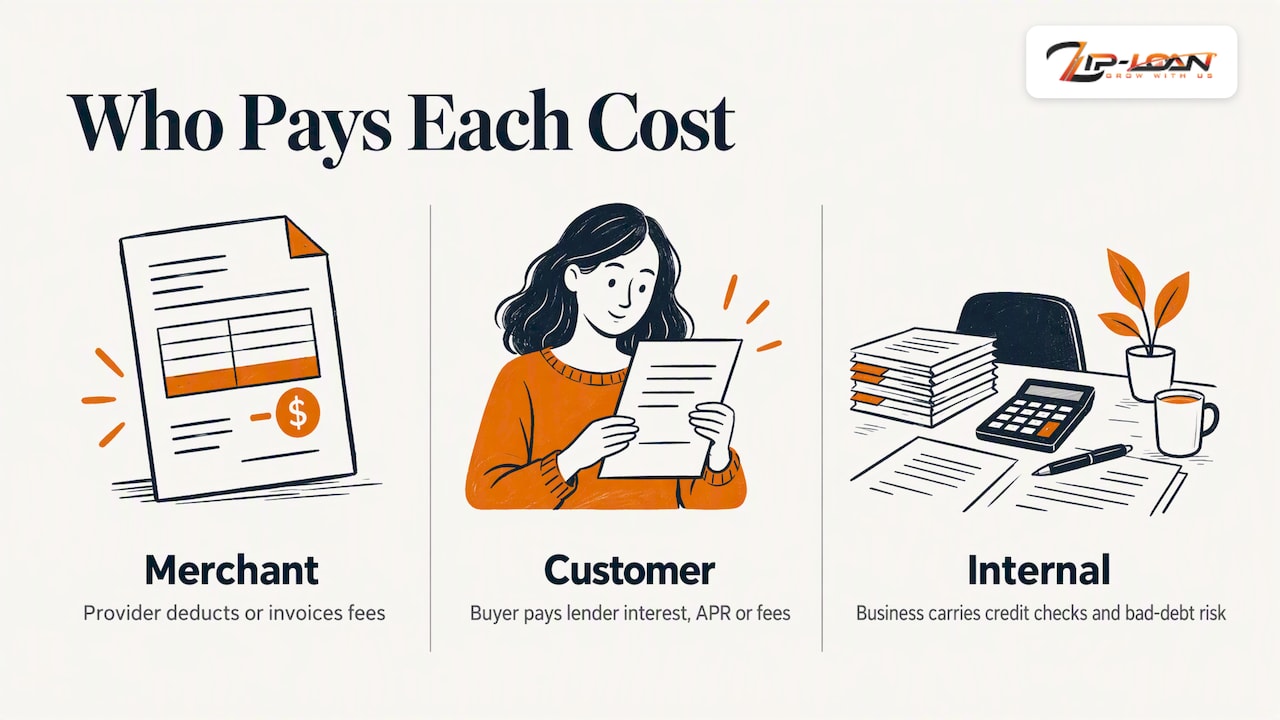
Merchant-side costs. These are the fees the provider deducts or invoices. Third-party lenders often fund a purchase upfront and pay the business the sale amount minus a fee, so the fee shows up as a discount on the funded amount rather than a separate bill.
Customer-side costs. Interest, APR, lease markup or fees are paid by the buyer to the lender or lessor. They shape approval rates and conversion, and they carry disclosure obligations, but they are not a line on your invoice. We cover the compliance side in our TILA compliance guide for retailers.
Internal costs. If you finance customers yourself, you carry credit checks, collections, software, staffing, administration, bad-debt risk and delayed cash flow, all of which Swoop lists as the price of the in-house route.
The framing that holds up across sources is a margin-versus-risk decision. Merchant Maverick describes outsourcing as a way to get faster or upfront payment and reduce collections exposure, with the trade-off that you must decide whether provider charges are outweighed by higher conversion and sales.
The main fee components you will see
Providers package pricing differently, but most quotes decompose into the same building blocks.
| Component | What it is | Who usually pays | What to ask |
|---|---|---|---|
| Per-transaction fee | A small flat amount per funded or processed loan | Merchant | Is it charged on approvals or only on funded loans? |
| Percentage of credit provided | Often a 2.5% to 5% range in third-party programs | Merchant | Does the rate vary by credit tier or product type? |
| Startup or setup fee | One-time onboarding or integration charge | Merchant | Is it waived or credited against volume? |
| Platform or software fee | Recurring fee for the platform or integration | Merchant | Is it fixed or tied to volume? |
| Termination fee | Charge for ending the contract early | Merchant | What is the minimum term? |
| Interest, APR or lease charges | The cost of the credit itself | Customer | How are these disclosed at checkout? |
Swoop’s US guide cites the per-transaction fee plus 2.5% to 5% range and also flags startup and termination fees as possible costs. Treat those numbers as a general market range for third-party programs, not a quote from any specific provider. Your actual rate depends on the program you choose.
For a deeper look at how each of these charges is structured, see our breakdown of customer financing fees: what merchants pay and why.
What drives the price you are quoted
Pricing is rarely a single dial. Five variables move it most.
In-house versus third-party
In-house financing avoids a provider service fee, but it leaves your business responsible for underwriting, billing, collections, compliance, working-capital needs and customer defaults. Third-party financing generally shifts most of those tasks and risks to the provider in exchange for fees, reduced margin or shared customer-finance revenue. For most small and mid-size retailers, the question is whether you want to be in the lending business at all.
Ticket size and volume
The Bank Policy Institute’s analysis of small-dollar lending shows that fixed technology and administrative overhead, plus expected repayment losses, can be large relative to the size of each loan. The same logic applies to your program: smaller tickets carry proportionally more fixed cost, while higher volume and automation give providers room to price more sharply.
Customer credit profile
A program built for prime borrowers has different loss expectations than one that approves subprime or no-credit-check applicants. Broader approval typically means more risk absorbed by the funding source, which can show up in pricing. It also means more of your customers are able to buy at all.
Integration requirements
A hosted payment link is cheaper to launch than a custom build into your point-of-sale or ecommerce stack. If you run on a common platform, a prebuilt connection reduces startup effort; see our overview of Square financing integration as an example of what a plug-in setup looks like.
Provider terms
Funding speed, recourse, dispute handling and contract length all influence what you effectively pay. These are covered in the checklist below.
A worked example: net margin per approved sale
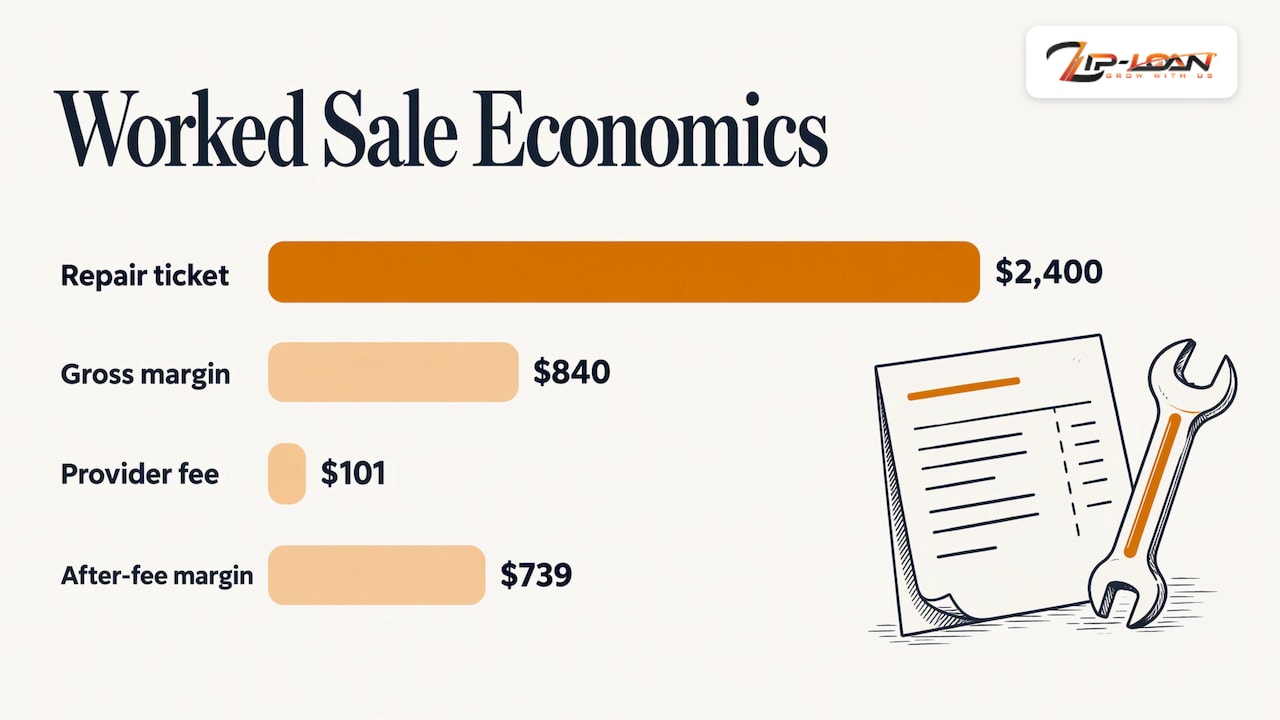
Here is a simple illustration using round, hypothetical numbers. They are not a ZipLoan quote.
Suppose you run an auto repair shop with a $2,400 average repair ticket and a 35% gross margin, which is $840 per job. Assume a provider charges 4% of the credit provided plus a flat $5 per transaction.
- Provider cost: 4% of $2,400 is $96, plus $5, for a total of $101.
- Gross margin after financing cost: $840 minus $101 is $739.
- Cost as a share of the sale: about 4.2%.
Now compare two outcomes. Without financing, a customer who cannot cover $2,400 today defers the repair or goes elsewhere, and you earn $0. With financing, you earn $739. The fee is only meaningful when it applies to a sale you would have made anyway. That is why the useful metric is the incremental margin from sales that would not have closed, plus any lift in average ticket, minus the fees on all financed sales.
A quick break-even check:
- Estimate how many financed sales would have closed without the program.
- Multiply those by the fee cost to find your “subsidy” on sales you would have won regardless.
- Estimate incremental sales and their margin.
- The program pays for itself when incremental margin exceeds that subsidy plus any fixed monthly or startup costs.
Our auto repair payment plans guide and home improvement financing guide walk through the same logic for higher-ticket service categories.
Single-lender versus multi-lender pricing
The structure of the lender network changes what your fees buy.
In a single-lender program, one funding source sets the approval criteria and the pricing. Underwriting is predictable and onboarding is simple, but any applicant outside that lender’s credit box is declined, and the merchant has limited leverage on rate because there is no competing offer behind it.
In a multi-lender program, an application passes through an automated waterfall: it goes first to the lender with the best terms for prime applicants and, if declined, cascades to the next lender serving near-prime, subprime or lease-to-own profiles. The practical pricing implications are:
- Approvals per application rise, so a given fee structure is spread across more funded sales.
- Fees can differ by tier, because a lender serving higher-risk customers prices that risk differently. Ask for the schedule by tier, not a single blended number.
- Customers see terms matched to their profile, which supports conversion without you managing multiple lender relationships.
Because pricing for these structures is set per program, there is no universal benchmark for the difference. The comparison that matters is approval rate and net margin per application, not fee per funded loan alone. You can see how we structure this on our multi-lender financing options page, and our guide to lease-to-own versus installment credit explains why product type also affects cost.
Contract terms to check before you sign
Headline rates get the attention, but the contract determines what you actually keep. Merchant Maverick’s checklist points to provider fees and their effect on profit, referral fees or commissions, returns, disputes, chargebacks and defaults, customer service, funding timing, and contract duration with early termination penalties. Turn that into questions for every provider you evaluate:
- Fee schedule. What is charged per transaction and as a percentage, and does either change by credit tier, product or volume?
- Recourse. If a customer defaults or disputes the purchase, does the loss fall on you or on the lender? Non-recourse funding protects your cash; recourse terms put it back at risk.
- Funding timing. When do you receive funds, and at what point does a sale officially count as funded?
- Returns and cancellations. How are fees treated when a customer returns the item or cancels the service?
- Contract length. What is the minimum term, and what are the early termination charges?
- Setup and recurring charges. Are there startup, integration or platform fees on top of the transaction fees?
- Customer support. Who handles borrower questions, and how are complaints routed?
- Eligibility and enrollment. What does the provider need from your business to approve you? Our guide to merchant financing program requirements outlines the typical enrollment items.
Disclosure and compliance costs
Consumer credit disclosures are a legal obligation, and errors are expensive. In 2017, the CFPB’s stipulated order against B&B Pawnbrokers required the company to disclose consumer-finance contract information fully and accurately under the Truth in Lending Act and Regulation Z, and barred incorrect APR disclosures. The takeaway for a merchant is to confirm which party issues the disclosures and how checkout displays them. When a provider handles that layer, it should be part of what you are paying for. If you structure any financing in-house, speak with a compliance attorney before launch.
Why a low rate is not always the low price
The Bank Policy Institute notes that lenders bear costs for applicant verification, origination platforms, technology and cybersecurity, marketing, administration, legal and regulatory compliance, complaint monitoring, delinquency workouts and losses, and that those costs affect pricing. A provider quoting a very low fee has either cut one of those functions, narrowed its approvals to the safest applicants, or recovers cost elsewhere in the contract. Three practical checks follow:
- Approval rate. A cheap program that declines half your applicants is more expensive per closed sale than a pricier one that approves most of them.
- Funding reliability. Delays in settlement have a carrying cost for a small shop.
- Total program cost. Add setup, platform and termination terms to the per-sale fee before comparing.
Our perspective
Most merchants we talk to start with one question: “What is the rate?” We understand why. But the rate is only one input to a decision that is really about conversion, risk and cash flow.
We built ZipLoan around the idea that financing should not exclude customers because of their credit. That is why we support all credit types, with single-lender or multi-lender structures, and why we design payment programs around what your customers can actually manage. When a customer who would have walked away can finish a purchase, the fee on that sale is the cost of revenue you would not otherwise have had.
Our advice is to price a program on net margin per application, not on fee per funded loan. Measure approvals, funded volume and average ticket for a full quarter, then compare. A streamlined application and a flexible lender structure are designed to raise the numerator in that equation, and that is where we focus our effort.
Joe
How ZipLoan fits your pricing evaluation
If you are comparing programs, we can help you map your ticket sizes and customer mix to the structure that suits them. ZipLoan is a retail financing platform for businesses such as automotive repair, healthcare, home improvement, furniture and jewelry, offering installment loans, lease options, no-credit-check financing and private label credit, with POS and ecommerce integrations.

To see the options side by side, start with our retail payment plan solutions comparison, or go straight to offering payment plans to your customers. If you want to talk through your own numbers, you can reach us from zip-loan.com.
Steps to build your own pricing comparison
- Collect your baseline. Pull average ticket, gross margin, and the number of customers who decline or defer a purchase on price.
- Request written fee schedules. Ask each provider for per-transaction fees, percentage rates by tier, setup charges and termination terms.
- Model three scenarios. Use conservative, expected and optimistic assumptions for approval rates and incremental sales.
- Compare net margin per application. Include every fee, not just the headline rate.
- Pilot before scaling. Run one location or product line first and review results against your model. Our setup guide covers the rollout.
If you want a fast route to launch, turnkey consumer financing packages the integration, application and funding in one program.
FAQ
How much does it cost a merchant to offer customer financing?
With third-party lenders, costs typically include a small per-transaction fee plus about 2.5% to 5% of the credit provided, per Swoop’s US guide. Startup or termination fees may also apply. Your actual price depends on the program, volume and credit mix, so request a written fee schedule.
Is in-house financing cheaper than a third-party program?
In-house financing avoids a provider’s service fee, but you take on underwriting, billing, collections, compliance and customer defaults, as Merchant Maverick explains. Those functions carry staffing, software and bad-debt costs, and delayed cash flow. Most merchants find a third-party program simpler to run.
Do customers or merchants pay the interest?
Customers pay interest or finance charges to the lender under the terms they accept at checkout. The merchant pays the provider’s fees. Disclosure rules under the Truth in Lending Act apply to the credit itself, so confirm who issues them in your program.
What should I look for in a financing contract?
Focus on fee structure, recourse for defaults and chargebacks, funding timing, treatment of returns, and contract length with early termination penalties. These terms often matter as much as the rate.
Does a multi-lender program cost more?
Not necessarily. Fees can vary by credit tier, but a multi-lender waterfall can increase approvals, which spreads cost across more closed sales. Compare net margin per application rather than the fee on any single loan.
Sources
- Customer financing: What is it & how to offer it, Swoop US
- Customer Financing Programs Guide, Merchant Maverick
- Customer financing: A guide for small businesses, QuickBooks
- Costs and Pricing of Bank-Provided Small Dollar Loans, Bank Policy Institute
- CFPB stipulated final judgment and order, B&B Pawnbrokers (2017)
Recommended
- Customer Financing Fees: What Merchants Pay and Why
- Auto Repair Payment Plans: 2026 Merchant & Consumer Guide
- The Ultimate Merchant’s Guide to Retail Financing Options in 2026
- Merchant Financing Program Requirements: Your 2026 Guide to Enrollment
Disclaimer: This article is provided by Zip Loan (Touch N Buy LLC d/b/a Zip Loan) for general informational and educational purposes only and does not constitute financial, legal, or professional advice. While we strive for accuracy, information may be incomplete, outdated, or subject to change without notice. Financing programs, rates, terms, and approvals vary by lender and applicant and are not guaranteed. Zip Loan makes no warranties regarding the information provided and, to the fullest ext