

Did you know that 30% of your potential shoppers will walk away today if they do not see a financing option at checkout? It is a frustrating reality for growth-minded business owners who want to scale but feel paralyzed by the red tape of consumer credit laws. You likely worry that one wrong move with interest rates or a missing disclosure could trigger a predatory lending lawsuit. You are right to be cautious, but you should not let regulatory anxiety stall your expansion. Learning how to offer payment plans to customers legally is about more than just checking boxes; it is about building a foundation of trust that turns hesitant browsers into loyal, high-value clients.
This guide provides a clear roadmap to mastering 2026 compliance standards, from the updated $73,400 Regulation Z threshold to the nuances of the Four-Installment Rule. We will show you how to implement a high-conversion strategy that eliminates the risk of debt collection and credit reporting headaches. By the end of this article, you will understand how to leverage multi-lender platforms like Zip-Loan to protect your business while offering the flexible terms your customers expect. Let’s explore the specific steps to unlock this growth potential without the legal baggage.
Key Takeaways
- Master the “four-installment rule” and current 2026 federal thresholds to ensure your business stays ahead of evolving consumer credit regulations.
- Discover how to offer payment plans to customers legally by choosing a model that transfers “Lender of Record” liability away from your balance sheet.
- Identify the mandatory Regulation Z disclosures, including APR and payment schedules, that are essential for maintaining transparency and building client trust.
- Leverage automated multi-lender platforms to provide instant approvals while shielding your business from the complexities of debt collection and credit reporting.
- Accelerate your growth by implementing pre-vetted legal frameworks that turn compliance from a hurdle into a strategic competitive advantage.
The Legal Landscape of Consumer Payment Plans in 2026
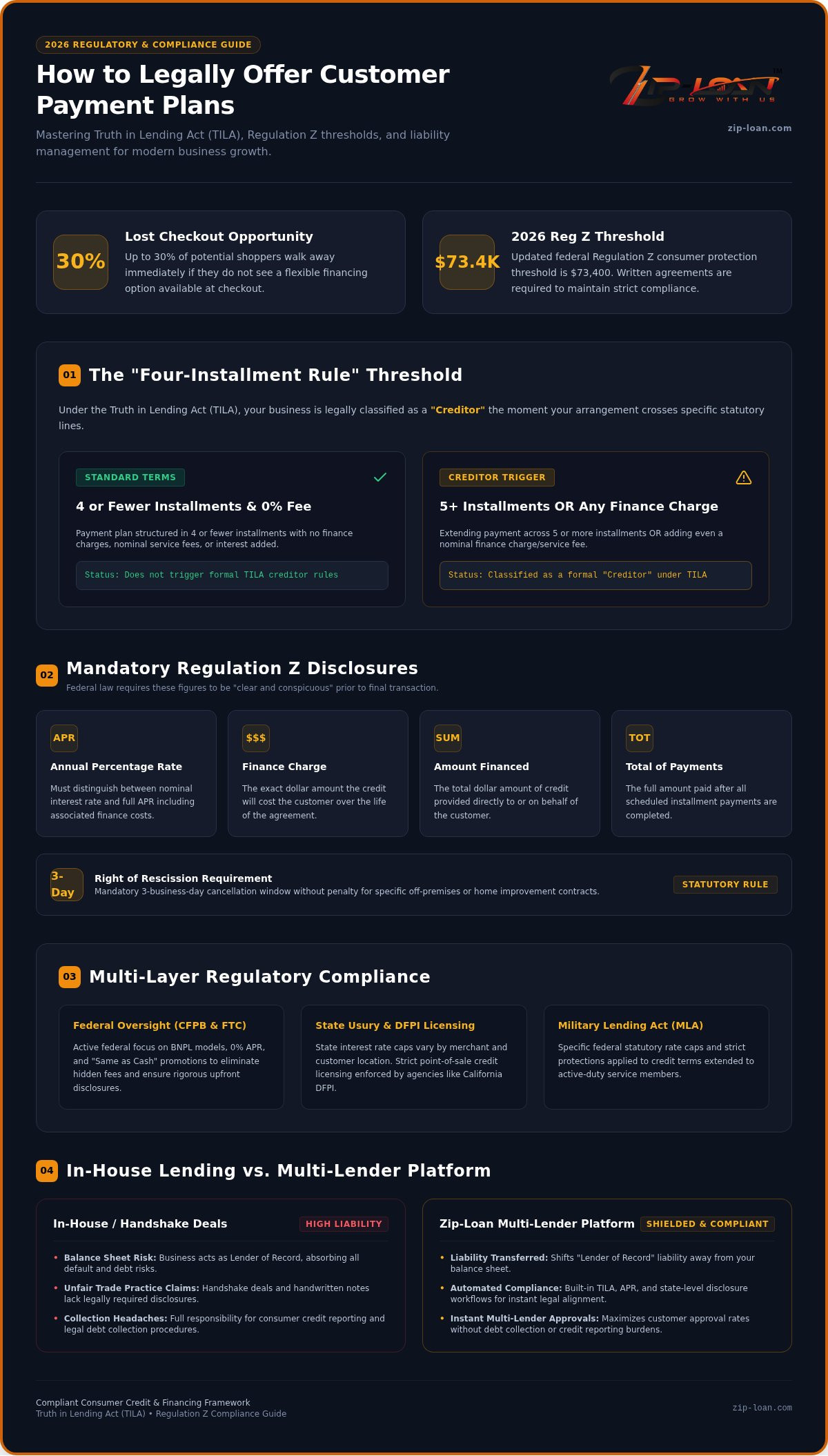
Transform your sales process by mastering the regulatory framework that governs modern consumer credit. What exactly transforms a simple payment arrangement into a legally regulated credit transaction? Under the Truth in Lending Act, your business is classified as a “creditor” the moment you extend credit that is subject to a finance charge or payable in more than four installments. This “Four-Installment Rule” remains the definitive benchmark for 2026. If you allow a customer to pay over five installments or add even a nominal service fee, you have officially crossed the threshold into formal lending. Understanding these boundaries is the first step in learning how to offer payment plans to customers legally without inviting unnecessary scrutiny.
The regulatory environment in 2026 demands absolute transparency. The Consumer Financial Protection Bureau (CFPB) and the Federal Trade Commission (FTC) have shifted their focus toward “Buy Now Pay Later” models, ensuring that even 0% APR or “Same as Cash” promotions include rigorous disclosures. These agencies, alongside state-level regulators, want to ensure that consumers aren’t misled by hidden fees or complex terms. By prioritizing clear communication now, you remove the barriers that often prevent high-ticket sales from closing. You can see why transparency is a growth strategy in our guide on why financing is essential for modern business expansion.
Federal vs. State Lending Regulations
State usury laws create a complex patchwork of interest rate caps that vary significantly across the country. Your compliance strategy must account for both your business location and the customer’s residence, as some state regulators, like California’s DFPI, apply strict licensing laws to point-of-sale credit. Additionally, the Military Lending Act (MLA) imposes specific limitations on credit extended to active-duty service members. Managing these variables is vital for maintaining a professional, growth-oriented operation that avoids the pitfalls of localized legal conflicts.
Why ‘Informal’ Handshake Deals Are a Legal Risk
Eliminate the danger of undocumented installment plans. Hand-written notes or verbal agreements for monthly payments are significant legal liabilities that can trigger “unfair trade practice” claims. Without a documented agreement that meets the 2026 Regulation Z threshold of $73,400 for consumer protections, you leave your business vulnerable to lawsuits and uncollectible debt. Every arrangement requires a written contract with clear terms. This documentation protects your revenue and ensures you are following the best practices for how to offer payment plans to customers legally while maintaining a catalytic pace for your business growth.
Core Compliance: Truth in Lending Act (TILA) and Regulation Z
Success in modern retail requires more than just a great product; it demands a sophisticated understanding of consumer credit law. Many business owners mistakenly believe that the Truth in Lending Act (TILA) only applies to traditional banks. In reality, any merchant who offers terms with five or more installments or applies a finance charge is legally classified as a “creditor.” This shift in status triggers a series of mandatory obligations under CFPB Regulation Z regulations. Learning how to offer payment plans to customers legally starts with acknowledging your role as a lender in the eyes of the federal government.
Transparency is your most powerful tool for building customer confidence and removing barriers to purchase. To remain compliant, you must provide clear, written disclosures before the transaction is finalized. These include the Annual Percentage Rate (APR), the finance charge, the total amount financed, and the total of all payments. Federal law requires these figures to be “clear and conspicuous,” meaning they shouldn’t be buried in fine print or hidden in complex legal jargon. For specific off-premises sales or home improvement contracts, you must also respect the Right of Rescission, which gives consumers a three-business-day window to cancel the agreement without penalty. Mastering these requirements ensures your growth remains sustainable and protected from regulatory action.
Calculating and Disclosing the APR
Distinguish between your interest rate and your APR to avoid costly legal errors. While an interest rate covers the cost of the principal, the APR provides a comprehensive view by including all prepaid finance charges and service fees. Failing to account for these “hidden” costs can lead to significant TILA violations. Utilizing an APR calculator ensures your team provides precise, automated disclosures that eliminate manual calculation errors and maintain absolute transparency with every client. If you are looking to scale quickly, offering transparent financing options through a professional platform can simplify this entire calculation process for your staff.
Regulation Z Requirements for 2026
Adapt your operations to meet the latest 2026 standards for digital and mobile credit applications. As of January 1, 2026, the threshold for exempt consumer credit transactions has increased to $73,400, meaning almost all high-ticket retail and contractor services now fall under Regulation Z protections. You must use standardized forms, often referred to as the “Schumer Box,” to present terms in a format consumers can easily digest. Keep your digital trails clean by storing all credit applications and disclosure receipts for at least two years. These record-keeping practices are your best defense in an era of heightened regulatory oversight and are essential for anyone figuring out how to offer payment plans to customers legally while maintaining a catalytic pace for their business.
In-House vs. Third-Party Financing: Managing Liability
Choosing between managing credit in-house or partnering with a professional provider is the most critical decision your business will make this year. If you choose to act as your own lender, you assume full responsibility for the “Lender of Record” status. This means your business is directly liable for every regulatory misstep, from improper credit reporting to aggressive collection tactics. Understanding how to offer payment plans to customers legally involves weighing these operational burdens against the streamlined security of a third-party partner. While in-house plans might seem cost-effective initially, the hidden expenses of legal fees for drafting compliant contracts and the time spent managing Fair Credit Reporting Act (FCRA) duties can quickly erode your margins.
Partnering with a multi-lender platform shifts this massive liability away from your balance sheet. In this model, a financial institution serves as the creditor of record, absorbing the risk of default and the complexity of regulatory adherence. You must ensure your business follows the FTC Credit Practices Rule guidance, which prohibits specific unfair contract provisions like wage assignments or pyramiding late fees. By letting a platform handle the legal heavy lifting, you can focus on what you do best: closing deals and satisfying customers.
The Burden of Debt Collection
Managing defaults internally is a legal minefield. The Fair Debt Collection Practices Act (FDCPA) sets strict boundaries on how you can contact customers regarding late payments. One aggressive phone call or poorly worded email can lead to expensive litigation. Third-party financing eliminates this anxiety by providing immediate funding within 24 hours. You receive the full payment upfront while the lender handles the long-term collection process. This ensures your cash flow remains consistent and your reputation stays protected.
Data Security and Privacy Laws
Protecting sensitive consumer data is not optional. Merchants extending credit must comply with PCI standards and the Gramm-Leach-Bliley Act (GLBA), which mandates the safeguarding of non-public personal information. Building a secure infrastructure to store credit applications is an expensive, ongoing commitment. Centralized platforms solve this by using enterprise-grade encryption and secure cloud storage, ensuring you never have to worry about the legal fallout of a data breach. This allows you to scale confidently, knowing your customer data is handled with the highest level of professional care.
5 Steps to Legally Offering Payment Plans Today
Ready to move beyond theory and start scaling your revenue? Transitioning from a cash only model to a flexible payment environment requires a structured approach to remain compliant. While many retail guides focus on small e-commerce purchases, high ticket service providers in sectors like HVAC, home remodeling, and elective medical care face unique regulatory requirements. Mastering how to offer payment plans to customers legally ensures that your expansion is built on a stable, risk free foundation. Follow these five steps to implement a professional financing strategy that removes barriers to entry for your clients while protecting your business interests.
Step 1: Assessing Your Industry Needs
Tailor your financing model to match your specific average ticket size and project cycle. A contractor selling a $15,000 roof requires a different credit structure than a boutique retailer. You must choose between revolving credit for repeat business, installment loans for one time projects, or lease to own programs for essential equipment. Explore how different specific industries utilize these models to maximize their close rates. Aligning your credit offers with industry standards is the first step toward customer financing solutions for business growth that actually move the needle.
Step 2: Automating the Disclosure Process
Eliminate the risk of human error by removing manual paperwork from your sales process. In 2026, manual disclosure errors remain the primary cause of regulatory fines. Utilize modern tools like QR codes and text to apply links to deliver digital disclosures directly to the customer’s smartphone. This ensures they receive the required TILA information in a format they can actually read. Even when providing the instant approval experience that modern consumers demand, your system must include a mandatory pause for the customer to review and acknowledge the full federal disclosure statement before signing.
Protect your customers’ financial health by implementing a soft pull pre-qualification process. This allows shoppers to see their buying power without any impact on their credit scores, which builds immediate trust. Once the model is set, ensure your sales team is trained on what they can legally say. They should never quote specific interest rates or guarantee approval; instead, they should focus on the benefits of monthly affordability. Finally, establish a clear, written dispute resolution policy for all financed sales to handle refunds or service issues professionally.
Speak with a compliance expert today to secure your financing strategy.
Scaling Safely: The Zip-Loan ‘Financing in a Box’ Solution
Accelerate your business growth by deploying an all-in-one platform that acts as your regulatory shield. While previous sections detailed the complexities of TILA and the Four-Installment Rule, Zip-Loan simplifies these hurdles by connecting you to a network of 30 lenders. These institutions handle the legal heavy lifting, including mandatory disclosures and adverse action notices, so you don’t have to. You maintain your focus on sales while we ensure you understand how to offer payment plans to customers legally through a fully automated portal. This isn’t just a vendor relationship; it’s a catalytic partnership designed to remove the barriers between your current revenue and your idealized future.
Meet the heightened expectations of 2026 consumers with an “Instant Approval” experience that delivers results in seconds. Today’s shoppers expect transparency and speed, with 9 in 10 consumers anticipating immediate decisions at the point of sale. By offering promotional 0% interest plans through a compliant platform, you can drive a 15% to 30% increase in order size according to industry benchmarks. These promotions are pre-vetted to meet state and federal standards, allowing you to drive higher conversion rates without the fear of predatory lending lawsuits. Merchant enrollment is the first step toward accessing 100% approval programs specifically tailored for high-ticket sectors like auto repair and home contracting.
Removing the Risk of Sales Declines
Stop losing revenue to rigid underwriting standards. A single-lender approach often rejects nearly half of all applicants, but Zip-Loan’s multi-lender waterfall architecture achieves approval rates exceeding 85%. We serve all credit types, including near-prime and subprime tiers with scores as low as 550, while maintaining strict regulatory compliance. This ensures you can serve a broader audience without assuming the risk yourself. For a deeper dive into maximizing these opportunities, read our Consumer Financing Services: The Ultimate Merchant Guide.
Immediate Funding and Cash Flow
Eliminate the anxiety of customer non-payment forever. When you use Zip-Loan, you get paid in full within 24 hours of the transaction, even if the customer is paying over a 120-month term. The lender absorbs 100% of the default risk, effectively removing the debt collection burden we discussed earlier. This immediate funding model stabilizes your cash flow and provides the capital needed for rapid expansion. It is the most secure way to master how to offer payment plans to customers legally while keeping your operations lean and focused on growth.
Unlock Your Business Potential with Compliant Financing
Embrace the future of commerce by turning legal compliance into your ultimate competitive edge. You’ve seen that mastering how to offer payment plans to customers legally isn’t about navigating red tape; it is about building a foundation of trust that turns browsers into buyers. By automating disclosures and shifting “Lender of Record” liability to professional institutions, you protect your revenue while providing the flexibility your clients demand in 2026.
Transitioning to a multi-lender platform allows you to offer instant approvals for amounts up to $65,000 without the fear of manual errors or debt collection burdens. With funds delivered within 24 hours and approval rates exceeding 85% across all credit types, your business is positioned for immediate expansion. This is the catalyst your operation needs to reach its next breakthrough. You now have the roadmap to scale safely and confidently.
Take the first step toward a more scalable, risk-free future today. Your growth is waiting.
Frequently Asked Questions
Is it legal to charge interest on a payment plan for my customers?
Yes, it is legal to charge interest provided you comply with state usury caps and federal disclosure laws. Charging interest or fees makes you a creditor under the Truth in Lending Act, requiring specific paperwork and clear APR statements. Using a platform like ZipLoan shifts this burden to a network of 30 lenders. This ensures you get paid in full within 24 hours while the lender manages the interest and legal disclosures.
Do I need a special license to offer in-house financing?
You might need a license depending on your state and the volume of credit you extend. Many jurisdictions require a consumer lending or sales finance license once you exceed a specific threshold of transactions. Partnering with a third party allows you to avoid these licensing hurdles. You can focus on your core business while the lending platform handles the complex regulatory requirements and the legal status of the creditor of record.
What is the 4-installment rule in consumer lending?
The four-installment rule is a federal standard that classifies any written agreement payable in more than four installments as a credit transaction. Even if you don’t charge interest, these plans trigger Truth in Lending Act requirements. Understanding this rule is essential for anyone learning how to offer payment plans to customers legally. Exceeding this limit requires formal disclosures like APR and payment schedules to protect consumer rights and ensure full transparency.
How do I comply with the Truth in Lending Act as a small business?
Compliance requires providing a written disclosure statement before the customer signs the agreement. You must clearly state the APR, finance charges, the amount financed, and the total of payments. Small businesses often find manual compliance difficult due to the complexity of these calculations and record-keeping rules. Utilizing a platform that automates these forms ensures your business stays protected from regulatory fines while providing a professional experience for every high-ticket shopper.
Can I offer payment plans to customers with bad credit legally?
Yes, you can legally offer financing to customers across the entire credit spectrum. There is no law prohibiting credit offers based on score alone, provided you don’t engage in discriminatory practices. ZipLoan’s multi-lender waterfall approach achieves approval rates above 85% by including lenders who accept credit scores as low as 550. This allows you to serve the 60% of customers who were previously declined by traditional banks for high-ticket purchases.
What disclosures are required for a 0% interest payment plan?
Even with 0% interest, you must disclose the total of payments, the payment schedule, and any potential late fees. If the plan exceeds four installments, it falls under Regulation Z. These same as cash promotions require absolute transparency to prevent deceptive practice claims. Automated systems ensure these disclosures are delivered via text or email. This creates a digital trail that proves your business is following federal transparency standards for every transaction.
How do state usury laws affect the payment plans I offer?
State usury laws set the maximum interest rates you can legally charge a consumer. These caps vary significantly from state to state, making national compliance a challenge for growing businesses. If you operate across state lines, you must follow the laws of the customer’s home state. A professional financing platform manages these localized caps automatically. This ensures your credit offers are always within the legal limits of the specific jurisdiction without constant manual oversight.
Is a ‘Buy Now Pay Later’ plan considered a loan under the law?
Yes, most BNPL plans are legally classified as credit transactions or installment loans. Federal regulators increasingly treat these digital accounts as traditional credit products. This means they are subject to specific dispute rights and refund protections. Learning how to offer payment plans to customers legally involves using a platform that handles these evolving BNPL regulations. This shields your business from the liability of managing these accounts internally while meeting modern shopper expectations for instant approvals.