
An installment loan finances a purchase the customer will own, repaid with interest over a fixed term. A lease pays for the right to use an asset for a set period, and ownership happens only if the customer exercises a purchase option. For merchants, the practical question is not which one is better in the abstract. It is which one approves more of your buyers at a cost they can accept, while protecting your margin and your cash flow.
This guide compares the two structures on ownership, total cost, credit reporting, tax treatment and approval, then places layaway and buy now, pay later (BNPL) beside them, since shoppers ask about all four. The consumer-law examples come mostly from auto finance, where federal guidance is most detailed, but the mechanics carry over to furniture, jewelry, healthcare and home improvement.
TL;DR
- An installment loan ends in ownership and charges interest on a declining balance. A lease charges for use (in cars, mainly depreciation) and ends in a return, a renewal or a buyout.
- Lease payments are usually lower per month, but the FTC advises comparing total cost, not the monthly figure alone.
- Both can appear on a credit report, so neither is “no-risk” for the customer. Lease-to-own retail programs differ from auto leases, so read each contract.
- Offering both, ideally through more than one lender, lets you serve prime and non-prime buyers instead of losing the ones a single product declines.
Table of Contents
- The core difference: borrowing to own vs. paying to use
- Side-by-side comparison
- Total cost matters more than the monthly payment
- Credit impact: leasing is not invisible
- The merchant’s view: tax treatment and cash flow
- Layaway, BNPL and lease-to-own: where they fit
- How to choose: a decision framework for your counter
- Our perspective: offer a ladder, not a single rung
- Putting financing to work in your business
- Mistakes to avoid when presenting financing
- FAQ
- Sources
The core difference: borrowing to own vs. paying to use
With an installment loan, the customer borrows the price of the item, repays principal plus interest in equal payments, and owns the asset (often subject to a lien until the last payment). The FTC’s guidance on financing or leasing a car describes the same split: financing means paying toward ownership, while a lease is a contract to pay for the use of the vehicle over a set term, after which it goes back unless a purchase option is exercised.
Three structural differences follow from that:
- What the payment covers. A loan payment amortizes the full financed amount plus interest. A traditional auto lease payment covers the expected depreciation during the term plus a finance charge, which is why it is typically smaller.
- How the price of money is expressed. Loans carry an APR. Auto leases carry a “money factor.” The common shortcut of multiplying the money factor by 2,400 to estimate an APR is only a rough approximation, as this Edmunds forum discussion shows, because lease interest is computed on an average of the capitalized cost and the residual value rather than on a declining balance.
- Who carries usage risk. A lease contractually binds the customer to upkeep, insurance and condition standards. A buyer who owns the asset carries those risks too, but also keeps whatever value remains.
Side-by-side comparison
| Factor | Installment loan | Lease (including lease-to-own) |
|---|---|---|
| Ownership | Customer owns the item from the start, subject to any lien | Lessor owns it until a purchase option is exercised |
| Typical monthly payment | Higher, because it covers the full price | Lower for auto leases, because it covers depreciation and fees |
| Cost of credit | APR on a declining balance | Money factor or lease charge, often harder to read |
| End of term | Item is paid off and owned | Return, renew or buy out |
| Customer obligations | Repay, insure, maintain | Repay, insure, maintain to contract standards |
| Typical fit | Customers with established credit who want to keep the item | Customers who want lower payments or cannot qualify for a loan |
| Merchant tax angle | Customer’s purchase; your sale is a sale | Depends on how the contract is structured (see below) |
Note that retail lease-to-own programs for furniture, jewelry or tires are not the same product as a 36-month auto lease. They are typically rental-purchase agreements with an early-buyout path, and the total paid if the customer goes to full term can exceed the sticker price by a wide margin. That is the trade-off for approvals that do not depend on a strong credit file.
Total cost matters more than the monthly payment
The lower monthly figure on a lease is real, and it is the reason leasing appeals to cost-conscious buyers. But FTC guidance tells consumers to look at the sum of all payments plus any down payment. Longer loan terms, such as 72 or 84 months, also lower the monthly payment while increasing the total interest paid and the risk of owing more than the item is worth.
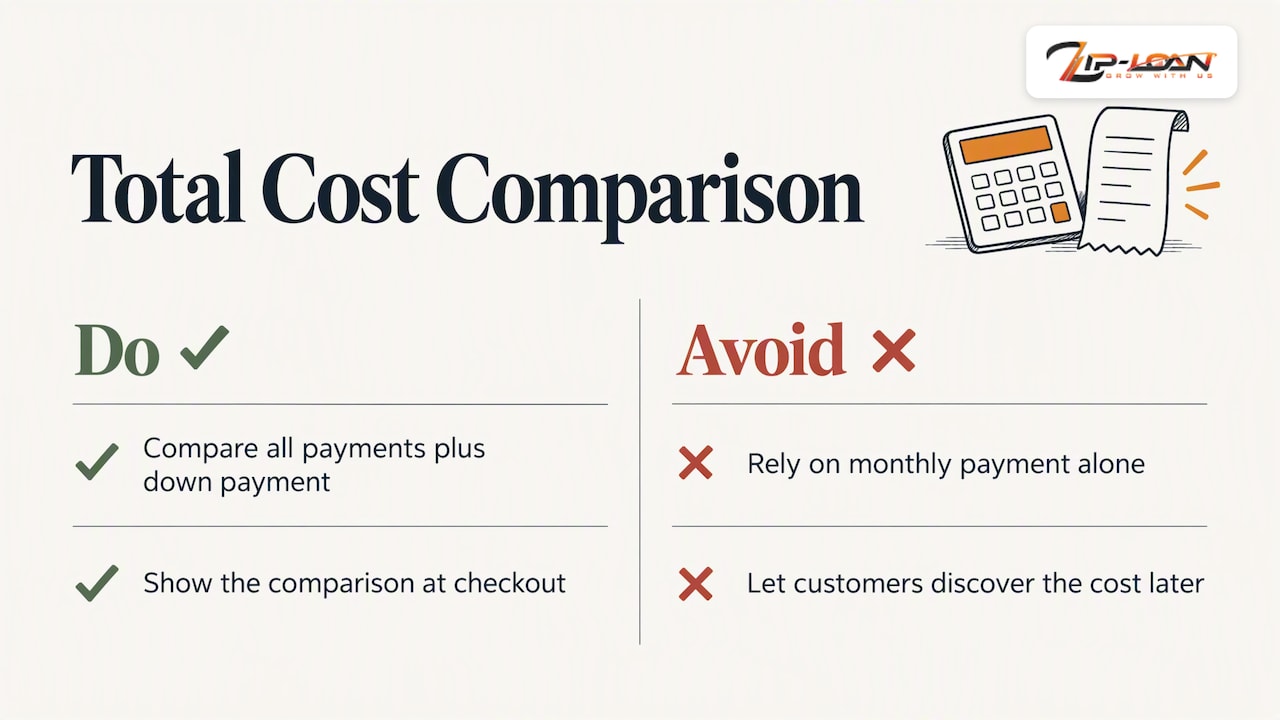
A simple illustration, using made-up round numbers for explanation only: a $3,000 repair or purchase repaid over 12 months at a modest APR will cost the customer a few hundred dollars in finance charges. The same $3,000 through a lease-to-own agreement may carry a lower approval bar but a much higher total if the customer pays to term. Neither is wrong. They serve different buyers, and your job is to make the comparison visible at checkout so that the customer does not discover it later and blame you.
What to put in front of the customer
- The total of payments, not only the payment amount
- The term and what happens at the end
- Any early-buyout window and its terms
- What happens on a missed payment
The FTC also advises agreeing on the “out-the-door” price before talking about financing or leasing, so the financing structure cannot hide a weak price. The same discipline protects your reputation in any retail category.
Credit impact: leasing is not invisible
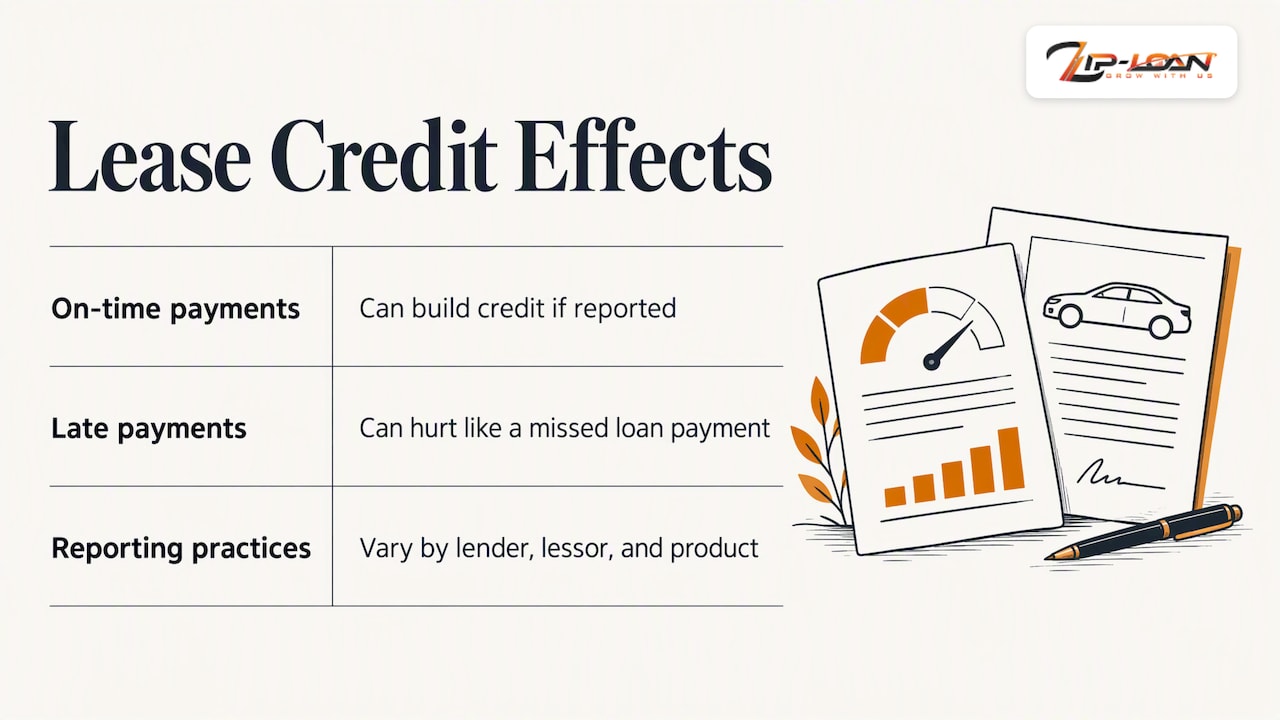
Many shoppers assume a lease is a rental that never touches their credit. In auto leasing that is often wrong. Experian explains that a car lease can help build credit when payments are made on time and reported to the bureaus, and that late payments can hurt in the same way a missed loan payment would. The CFPB’s 2015 rule on auto leasing likewise treats leasing as functioning like a financed purchase: it involves an application, a look at credit history and a commitment to a stream of payments.
For merchants this has a practical consequence. If a customer asks “will this affect my credit?”, the honest answer depends on the lender or lessor and the product. Train staff to say that reporting practices vary by program and point to the disclosure, rather than promising either way.
The merchant’s view: tax treatment and cash flow
Two questions decide whether a financing structure helps your business.
Do you get paid up front? In most third-party consumer financing arrangements, the lender or lessor funds the merchant, and the customer repays the finance provider. The terms (including whether funding is recourse or non-recourse) differ by program, so confirm them in your agreement before you promise anything to your team or your customers.
What if you are the one leasing or buying equipment? This matters for business customers, such as contractors or clinics financing equipment. The IRS notes that the line between a lease and an installment purchase can blur. Under IRS guidance, an agreement may be treated as a conditional sales contract, rather than a lease, when payments build equity, when there is a nominal purchase option, or when payments are very high relative to fair rental value. In that case the payer capitalizes and depreciates the asset instead of deducting the payments as rent. If your customers are small businesses, suggest they confirm the treatment with their accountant before choosing.
Layaway, BNPL and lease-to-own: where they fit
The related searches around this topic show that shoppers and merchants lump several products together. They are not the same.
| Product | Customer gets the item | Credit or interest | Best for |
|---|---|---|---|
| Layaway | After the last payment | Usually no interest, though fees may apply | Planned purchases with time to wait |
| BNPL (pay in 4 or longer plans) | Immediately | Pay-in-4 often interest-free; longer plans may charge interest | Smaller tickets and impulse purchases |
| Installment loan | Immediately | Interest by APR | Larger tickets, customers with credit |
| Lease-to-own | Immediately | Lease charges, higher total if held to term | Customers who cannot qualify for a loan |
The CFPB, when it opened its inquiry into BNPL, described BNPL as the modern version of layaway, with one key change: the customer takes the product home right away but also takes on the debt right away. That is the crucial contrast with layaway. In layaway, the merchant holds the goods until the customer finishes paying, which ties up your inventory and delays your sale. In BNPL and installment financing, you hand over the goods at checkout and a finance partner carries the payment stream.
How to choose: a decision framework for your counter
Start with the customer, not the product.
- Prime customer, larger ticket, wants to keep the item. Offer an installment loan with a clear APR and term. It usually has the lowest total cost, and it ends in clean ownership.
- Near-prime or thin-file customer. A secondary installment program, with a higher rate but a loan structure, often keeps the sale without moving to a lease.
- Customer who is declined or has no usable credit history. A lease-to-own option can capture a sale that would otherwise walk out the door. Make the total cost and the early-buyout window explicit.
- Small ticket, immediate need. A short BNPL plan may be enough.
- Customer who can wait and distrusts debt. Layaway, if you are willing to hold the inventory.
The tension at the heart of this framework is that a single product cannot serve all five customers. A merchant who offers only one lender loses everyone that lender declines. That is the reasoning behind routing applications through a waterfall of lenders, from the lowest-cost option to the most flexible, so each applicant lands in the best structure they qualify for.
Our perspective: offer a ladder, not a single rung
We see the installment loan versus lease debate framed as a contest, and for merchants it rarely is. In our experience, the sales you lose are not lost because you picked the wrong product. They are lost because the customer’s credit profile did not match the one product you offered, or because the application felt like an obstacle.
Our approach at ZipLoan is built on three beliefs:
- Credit profiles are a spectrum. Prime, near-prime and subprime shoppers all walk into the same store, so a financing offer should cover all of them. That is why we support single-lender programs and a multi-lender platform, covering installment loans, lease options, no credit check financing and private label credit.
- The application should be quick and sit inside your existing flow. Integrations with POS and ecommerce systems keep the offer at the moment of purchase, which is when a customer decides.
- Transparency protects you. Showing total cost and end-of-term terms up front reduces disputes and builds the kind of repeat business that no financing promotion can buy.
If you take one idea from this article, take this one: match the structure to the customer, and measure results by approved sales and satisfied customers, not by the monthly payment you advertise.
— Joe
Putting financing to work in your business
If you want to see how these structures work together, ZipLoan lets you offer installment, lease and private label options through one integration, with multi-lender financing for the customers a single lender would decline. Our guide to retail financing options walks through the product types, and our lease to own vs. installment credit merchant guide goes deeper on prime, secondary and lease-to-own tiers. Auto shops can start with our auto repair payment plans guide, and you can browse the types of customer financing options you can add. To get started, visit zip-loan.com.
Mistakes to avoid when presenting financing
- Leading with the monthly payment only. It makes a long-term loan or a lease look cheaper than it is and invites complaints later.
- Calling a lease “no credit impact.” Reporting varies, and the Experian and CFPB materials above show why a blanket promise is risky.
- Treating lease-to-own as a loan. It is a different contract with a different end state. Say so plainly.
- Skipping staff training. Your team should be able to explain ownership, total cost and the buyout option in two sentences.
- Using one lender for everyone. Declines are lost sales. A second or third option recovers some of them.
FAQ
Is it better to lease or get a loan?
It depends on whether the customer wants to own the item and what they can qualify for. A loan usually costs less in total and ends in ownership. A lease lowers the monthly payment, or opens approval to customers a loan would decline, but the customer should compare the total of all payments before signing.
Is a lease considered an installment loan?
Not legally, but it behaves similarly on a credit report. Experian notes that auto leases can be reported to the bureaus, so on-time payments can help and late payments can hurt. Retail lease-to-own programs vary, so customers should check whether their provider reports.
What is the difference between lease-to-own and financing?
Financing is a loan: the customer owns the item and repays with interest. Lease-to-own is a rental-purchase agreement: the provider owns the item until the customer completes the agreed payments or buys it out early. Lease-to-own tends to approve more customers, and the total cost can be higher if held to term.
How does layaway compare with BNPL?
With layaway, the customer pays over time and receives the item at the end. With BNPL, the customer receives the item at once and repays afterward. The CFPB has compared BNPL to layaway while noting that the debt starts immediately.
What is the 90% rule in leasing?
There is no universal consumer rule by that name. The figure most often cited comes from tax rules for Opportunity Zone property, and applies to Qualified Opportunity Funds and their businesses, as the IRS Opportunity Zones FAQ covers. Ask your accountant which test applies to a specific business lease.
Sources
- FTC: Financing or Leasing a Car
- Experian: Does Leasing a Car Build Credit?
- Edmunds Forums: Money factor x2400 and APR
- CFPB: Defining larger participants of the automobile financing market and automobile leasing activity
- IRS: Income & Expenses 7
- CFPB: Inquiry into Buy Now, Pay Later credit
- IRS: Opportunity Zones frequently asked questions
Recommended
- Lease to Own vs. Installment Credit: 2026 Merchant Guide
- Types of Customer Financing Options
- Small Business Customer Installment Plans: The 2026 Growth Blueprint
- Lease to Own Programs for Small Business Customers: The Comprehensive Merchant Guide
Disclaimer: This article is provided by Zip Loan (Touch N Buy LLC d/b/a Zip Loan) for general informational and educational purposes only and does not constitute financial, legal, or professional advice. While we strive for accuracy, information may be incomplete, outdated, or subject to change without notice. Financing programs, rates, terms, and approvals vary by lender and applicant and are not guaranteed. Zip Loan makes no warranties regarding the information provided and, to the fullest ext