

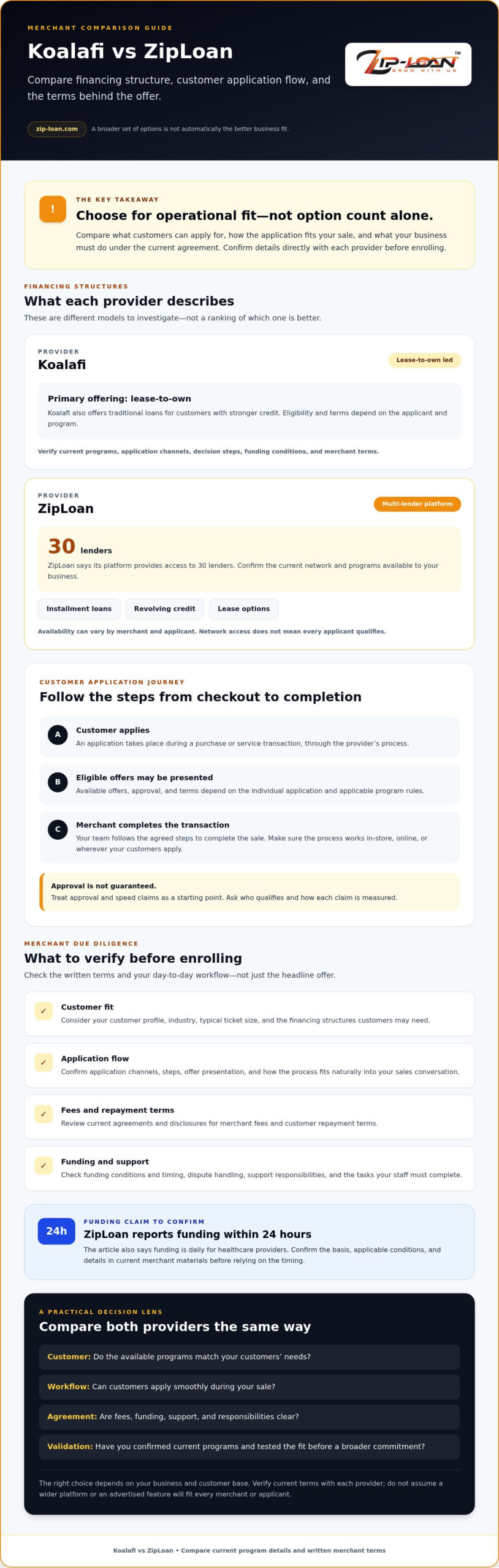
What if the financing provider with more options isn’t automatically the better fit for your business? In the Koalafi vs Zip-Loan comparison, the financing models matter: Koalafi primarily offers lease-to-own financing alongside loan options, while Zip-Loan connects merchants with a network of lenders through one platform. Zip-Loan says its platform provides access to 30 lenders, but confirm the current network and available programs before enrolling.
Look beyond the headline offer. Your customers’ application experience, available financing, merchant requirements, fees, funding conditions, and support can all affect whether a program works for your business. Approval and speed claims are useful only when you understand who qualifies, how the claims are measured, and what the agreement actually says.
This comparison explains how to assess financing options for your industry and customer base, what to verify with each provider, and how to weigh flexibility against operational fit. Use the practical checks below to evaluate Zip-Loan’s current lender network, products, application flow, and merchant terms without assuming that a broader platform is right for every business.
Key Takeaways
- In the Koalafi vs ZipLoan comparison, assess financing structure and application flow alongside customer eligibility, not just the number of options.
- Check whether each provider’s application process fits your sales workflow and your customers’ needs.
- Treat approval claims as a starting point. Confirm eligibility criteria and how approvals are measured.
- Review current agreements for merchant fees, funding conditions, dispute handling, and operational responsibilities before enrollment.
- Use the same step-by-step evaluation for both providers, then test the fit before making a broader commitment.
Koalafi vs ZipLoan: What a merchant should compare first
Customer financing should work for the person making a purchase and the team completing the sale. A useful comparison goes beyond a headline approval claim. Look at whether the options suit your customers, fit your sales process, and make sense for your business operations.
Point-of-sale financing lets a customer apply for payment options during a purchase or service transaction. In the Koalafi vs ZipLoan comparison, the goal isn’t to declare a universal winner. It’s to assess provider fit by comparing financing types, the application journey, merchant costs, funding, and support, then verify those details against current terms.
For a quick look at how financing may be presented in a customer conversation, watch this video:
What does a point-of-sale financing provider do?
During checkout, a customer applies through the provider’s process and may receive offers for which they’re eligible. The provider or financing network facilitates the financing, while your business sells the product or service and follows the agreed steps to complete the transaction. Approval, available terms, and program availability depend on the individual application and applicable program rules. Don’t present financing as guaranteed.
Why compare providers by business needs?
Start with the details of your operation. A retailer selling higher-ticket products may prioritize the available financing structures and a smooth in-store or online application. A contractor may focus on how customers apply while reviewing a project estimate. An auto-repair or healthcare business may have different transaction and workflow needs.
Consider your typical ticket size, customer profile, industry, and where an application fits into the sale. ZipLoan offers access to multiple lenders and installment, revolving credit, and lease-to-own options. Confirm which programs are currently available to your business and customers. Likewise, check Koalafi’s current program details rather than assuming advertised features apply to your business or every applicant.
Before enrolling, review current agreements and disclosures for fees, repayment terms, funding conditions, support responsibilities, and the steps required of your staff. The overview of customer financing benefits can help frame the opportunity, but your workflow and the written terms should guide your decision. For background on the similarly named Zip Co, consult its company overview. That information alone doesn’t establish ZipLoan’s current merchant terms.
Koalafi vs ZipLoan: How financing options and applications differ
Compare both the financing structure and the steps customers take to apply. Keep confirmed program details separate from claims you still need to check. ZipLoan offers installment loans, revolving credit, and lease options through a multi-lender platform. Availability can vary by merchant and applicant, so confirm the programs offered to your business.
| Comparison point | Koalafi | ZipLoan |
|---|---|---|
| Financing structure | Lease-to-own is its primary offering. It also offers traditional loans for customers with stronger credit. | Offers installment loans, revolving credit, and lease options. Verify which are currently available to your business and customers. |
| Application flow | Confirm current application channels, steps, and the decision process with Koalafi. | Confirm the current application steps and how the multi-lender process presents offers to applicants. |
| Eligibility | Eligibility and terms depend on the applicant and program. | Eligibility and terms depend on lender decisions and program rules. Access to a lender network doesn’t mean every applicant qualifies. |
| Funding | Verify applicable funding conditions and timing in current merchant materials. | ZipLoan reports funding within 24 hours, or daily for healthcare providers. Confirm the basis and conditions before relying on that claim. |
| Support | Ask what support is included and who handles servicing. | Confirm merchant support, servicing responsibilities, and how questions or disputes are handled. |
Which financing structures should merchants compare?
An installment loan is repaid in scheduled payments. Revolving credit lets a customer draw against an approved credit line, subject to its terms. With a lease option, the customer makes payments under a lease agreement, and ownership conditions depend on that agreement. For Koalafi vs ZipLoan, compare the repayment schedule, promotional conditions, and who services each arrangement. The SBA guidance on funding your business offers broader context on business funding choices.
How do customers apply and receive an offer?
Ask each provider to walk through the application from the customer’s point of view. Where does it begin? What information does the customer need to provide? How are offers presented, and what happens next? Don’t treat prequalification as final approval. It may indicate potential options, while a completed application is assessed under the lender’s process. Confirm decision timing and any credit-check details directly instead of assuming they’re the same across providers.
Before enrollment, request current program materials and agreements so your team can explain the options accurately. To review ZipLoan’s merchant information as part of your evaluation, visit ZipLoan’s website.
Koalafi vs ZipLoan merchant costs, funding, and support: what to verify
A high approval claim alone can’t show whether a financing program adds value to your business. The practical test is what happens after an application: what your business pays or must do, when funds arrive, who handles customer questions, and how the arrangement affects your workflow. In the Koalafi vs ZipLoan comparison, use current written disclosures rather than relying on a headline or verbal summary.
How should merchants assess fees and contract terms?
Request a complete schedule of merchant charges from each provider, including exceptions, promotional conditions, and transaction-specific requirements. Review the agreement for its term, renewal and cancellation provisions, transaction handling, and responsibilities if a customer raises a dispute. Don’t assume that similar financing options carry similar merchant obligations.
To estimate the operational impact, use your own transaction records. Consider which purchases might involve financing, what steps staff would need to complete, and how contract charges or requirements could affect your margins and processes. Generic projections can’t replace your business’s own numbers. A practical offer-comparison framework, such as Forbes’ guide to how to get a business loan, can help you organize questions before reviewing provider terms.
What should you confirm about funding and support?
Funding claims need context. ZipLoan reports merchant funding within 24 hours, or daily for healthcare providers, but these are not guaranteed timelines. Ask what event starts the clock, what conditions must be met, whether exceptions apply, and how transactions are reconciled. Koalafi’s published information describes funding 48-72 business hours after merchandise is received by the customer and marked delivered in the merchant portal. Confirm that timing and its conditions in current merchant materials before comparing it with another provider.
- Clarify responsibility: Ask who handles customer servicing, payment questions, and disputes, and what your staff must do.
- Map support: Confirm what onboarding and staff training involve, how technical issues are reported, and how concerns are escalated.
- Check the evidence: Treat testimonials and performance figures as directional unless the provider explains the measurement method, timeframe, and eligibility conditions.
Record the answers in a side-by-side review, then check them against each provider’s agreement and disclosures. If a claim isn’t reflected in the written terms, ask for clarification before enrollment. This helps you compare the full operating relationship, not just the appeal of a fast decision or a broad financing offer.
How to choose between Koalafi and ZipLoan for your business
The right choice depends on your customers and how financing fits into the sale, not on a universal ranking. Use the Koalafi vs ZipLoan comparison to create a consistent evaluation, then verify each provider’s current offers, eligibility rules, and merchant terms before deciding.
Which provider fits your customer and transaction mix?
Start with your typical transaction size, whether customers need to make a quick decision, how often they return, and where financing fits in the customer journey. A retailer, contractor, and healthcare provider may have different priorities and workflows. Consider whether installment, revolving credit, or lease-based options are relevant, but confirm which are available to your business and customers. Check actual eligibility and terms rather than assuming a program will reach every customer you want to serve.
How can a merchant compare providers fairly?
Give both providers the same scenarios and questions. Ask how a customer applies, what offers may be presented, what your staff must do, and how transactions are funded and supported. Score each response based on current written information. For retail businesses, compare how the financing process fits both in-store and online sales, where applicable.
Use this six-step checklist to move from comparison to a confident decision:
- Define goals: Decide what you want financing to support, such as a smoother purchase process or payment options that better match customer needs.
- Map the workflow: Trace the application and sale from the customer’s first question through transaction completion. Identify staff tasks and potential friction.
- Verify offers: Confirm current financing structures, eligibility, application steps, and how offers are determined.
- Compare terms: Review fees, repayment conditions, funding rules, support, and contract obligations in each provider’s current disclosures.
- Pilot carefully: If the agreement permits, test the process with a limited rollout. Prepare staff to explain the options clearly without promising approval or particular terms.
- Review results: Gather customer and staff feedback, assess the workflow impact, and compare the actual experience with your goals before expanding.
Make the review specific to your industry. For example, a contractor may focus on how financing is introduced during a service estimate, while a healthcare business may examine its customer journey and funding arrangements. Explore ZipLoan’s industries served for relevant context, then confirm program details directly with each provider. Clear explanations matter: check whether customers understand the application, the offer presented, and the payment obligations before proceeding.
How ZipLoan can help merchants evaluate their next financing step
The strongest choice is the provider whose verified financing options, terms, and workflow fit your customers and business. In the Koalafi vs ZipLoan comparison, ZipLoan’s multi-lender platform and installment, revolving credit, and lease options are useful points to investigate, not automatic advantages. Confirm which lenders and options are currently available to your business and whether their requirements match the customers you serve.
What should you ask before enrolling with ZipLoan?
Use focused questions to turn an initial conversation into useful, comparable information. Ask for written answers about the current program and how it would work in your sales process:
- Which financing categories and participating lenders are available to your business now?
- What customer criteria apply, and what disclosures will customers see before choosing an offer?
- What are the current contract terms, merchant charges, funding conditions, and support procedures?
- How do enrollment and staff training work, and how would customers begin an application within your existing sales process?
Ask for details specific to your business rather than assuming a platform’s general description applies to every merchant or applicant. Eligibility, offers, and funding depend on program rules and individual circumstances.
How can you take the next step with confidence?
Prepare before speaking with a provider. Gather examples of your typical transactions, the questions customers ask about payment options, and the points in your sales process where an application could fit. This gives the conversation practical context and helps you judge whether the proposed process is clear for customers and staff.
Then compare ZipLoan’s written answers with the information you’ve gathered from Koalafi. Resolve unclear claims about eligible applicants, terms, funding, customer servicing, or implementation before making a decision. If a detail matters to your business, ask where it appears in the current agreement or program disclosures.
A multi-lender approach may be worth evaluating if you want to explore multiple financing structures through one platform, but the number of options alone doesn’t determine fit. Focus on which verified offers serve your customers, how your team will manage the process, and whether the contractual obligations work for your operation. That’s a more useful basis for a decision than a broad approval claim or feature list.
Bring your questions to ZipLoan’s team to discuss current program fit and merchant requirements. Discuss merchant financing options.
Choose with confidence, then move forward
The best next step isn’t choosing the provider with the boldest claim. Match verified program terms and the customer application experience to your business, then confirm that funding, support, and day-to-day requirements work for your team. That’s the practical takeaway from Koalafi vs ZipLoan: fit depends on your customers and operations, not a universal ranking.
ZipLoan’s platform provides access to multiple lenders and offers installment, revolving credit, and lease options. Confirm the current lender network, available programs, eligibility rules, merchant charges, and implementation terms. Compare the written answers with Koalafi’s current disclosures before deciding.
Bring your transaction patterns and workflow questions to a conversation with ZipLoan’s team. Clear answers can help you determine whether its current options merit a closer look, without committing your business to a program that doesn’t fit.
Discuss financing options for your business.
With careful verification and a measured evaluation, you can choose a path that supports your customers and gives your business room to grow.
Frequently Asked Questions
Is Koalafi or ZipLoan better for merchants?
Neither provider is automatically better for every merchant. The right fit depends on your customers, sales process, and verified program terms. Koalafi primarily offers lease-to-own financing and also has traditional loan options. ZipLoan provides access to a multi-lender platform, but confirm the current lender network and available programs. Compare eligibility, the customer application experience, merchant obligations, funding conditions, and support before choosing.
What is the difference between Koalafi and ZipLoan financing?
Koalafi’s primary model is lease-to-own, with traditional loans also available for some customers. ZipLoan offers a multi-lender platform with installment loans, revolving credit, and lease options. Confirm which programs are currently available to your business and customers. For either provider, compare repayment schedules, eligibility, promotional conditions, and who handles customer servicing. Lenders determine individual offers and terms.
Can merchants offer both Koalafi and ZipLoan?
Possibly, but don’t assume either provider permits or supports using both at the same time. Ask each provider about merchant eligibility, contract restrictions, enrollment requirements, and how multiple application options would fit your checkout or service workflow. Confirm that staff can explain the programs clearly and how customers choose between them. Get written confirmation before planning a combined offering or rollout.
How much does Koalafi or ZipLoan cost a merchant?
There isn’t one cost figure that applies to every merchant or program. Fees, promotional conditions, and other obligations depend on the current agreement and financing arrangement. Ask both providers for a complete written schedule of merchant charges, exceptions, and transaction requirements. Review funding and servicing terms as well. Compare the agreements against your own transaction patterns, and don’t rely on general claims in place of contract disclosures.
Does ZipLoan guarantee approval for every customer?
No. Access to a lender network doesn’t mean every customer will be approved or offered financing. ZipLoan provides access to multiple lenders, but each lender determines eligibility and terms based on its program rules and the applicant’s information. Ask ZipLoan to clarify current eligibility criteria and any approval claims, including how they’re measured. Make sure customers understand that an application may not result in an offer.
How quickly do merchants receive funds through ZipLoan?
ZipLoan reports merchant funding within 24 hours and daily funding for healthcare providers, but treat these as claims to verify, not guaranteed timelines. Ask what event starts the funding period, what conditions must be met, whether exceptions apply, and how transactions are reconciled. Confirm the applicable timing for your business in current merchant materials and the agreement before relying on it for cash-flow planning.
What should a business verify before choosing a point-of-sale financing provider?
Verify the financing options currently available, applicant eligibility, application steps, customer disclosures, merchant charges, funding conditions, and support responsibilities. Read the contract for its term, cancellation provisions, transaction handling, and dispute processes. Ask how enrollment and staff training work, and check whether the customer journey fits your sales workflow. Compare written answers from each provider using the same questions, then resolve unclear claims before making a decision.