

When merchants search for “Lightspeed financing integration,” they usually mean one of two different products. The first is Lightspeed Capital, a merchant cash advance built into the Lightspeed platform that funds your business. The second is consumer financing at checkout, where your customers split a purchase into installments or leases through a lender connected to your POS. This guide explains how each works, what Lightspeed Capital costs and requires, and how to decide which one solves the problem in front of you.
TL;DR
- Lightspeed Capital funds your business. It is a merchant cash advance offered through Lightspeed Commerce to eligible U.S. customers, repaid as a percentage of daily sales.
- It is invitation-based. Merchants using integrated payments are reviewed automatically each month, and an offer arrives by email if you qualify.
- Checkout financing is a separate tool. It gives your customers payment options, so you capture sales you would otherwise lose at the register.
- The two solve different problems. One gives you working capital; the other raises your conversion rate and average ticket.
Table of Contents
- Two meanings of Lightspeed financing integration
- How Lightspeed Capital works with your POS
- Eligibility: who gets an offer
- What the offer looks like: amounts, fees and repayment
- Is it a loan? How the structure is described
- Checklist before accepting any POS-based advance
- Where checkout financing fits
- What good POS financing integration looks like
- Choosing between merchant funding and customer financing
- Perspective: why customer financing deserves its own line item
- Offer your customers financing with ZipLoan
- FAQ
- Sources
Two meanings of Lightspeed financing integration
The phrase blends two ideas that sit on opposite sides of your counter.
Merchant-side financing is money your business receives. Lightspeed Capital belongs here. Lightspeed uses the sales data it already sees in your POS to decide whether to make you an offer, then deposits funds in your bank account and collects repayment from your card sales.
Customer-side financing is money your shopper uses to pay you. Installment loans, lease-to-own, no credit check programs and private label credit belong here. You are paid by the lender, and the customer repays the lender over time. This is the category ZipLoan operates in.
Knowing which one you need prevents wasted effort. If your register is busy but you cannot stock up for the busy season, you have a working capital question. If shoppers walk away at the price tag of a $2,400 repair, a sectional sofa or a diamond ring, you have a purchase affordability question.

How Lightspeed Capital works with your POS
Lightspeed Capital is offered seamlessly through the Lightspeed Commerce platform and is available to eligible U.S. customers. Funds can be used for business expenses such as equipment, inventory or staffing. Lightspeed describes it as a cash advance rather than a loan, so applying does not affect your credit.
The structure is tied to the platform. Because merchants use Lightspeed as their core operating system, the company has real-time visibility into performance, which Retail Insider reported lets it streamline eligibility, underwriting and risk management.
Where it came from
Lightspeed Capital launched in the U.S. in August 2020, powered by Stripe, for retailers using Lightspeed Payments. BetaKit reported that Stripe Capital financed the advances directly and that eligibility drew on a retailer’s history with Lightspeed Payments. In October 2021, Lightspeed extended the program to recently integrated merchants from the Upserve, ShopKeep and Vend acquisitions, which increased the share of its merchant base that could receive offers by roughly 40%.
Does it need Lightspeed Payments?
Yes. The original launch made it available to U.S. retailers using Lightspeed Payments, and the support center says merchants on integrated payments are the ones reviewed automatically. If you run a third-party processor, the program will not see enough of your sales to underwrite you, so confirm your payment setup before counting on an offer.
Eligibility: who gets an offer
You do not fill out a traditional application to start. According to the Lightspeed Capital Support Center:
- Eligible merchants are reviewed every month, based on factors including transaction volume and history.
- You are contacted by email if you qualify, and offers appear in the Back Office under Financial Services > Capital.
- An offer stays open for up to 30 days. After that it expires and you are reevaluated.
- You can have one active advance per location, and a location may qualify for renewal once 90% of the total amount owed has been repaid.
A professional review from United Capital Source adds that merchants typically need at least six months of payment history, that no credit check is performed, that the financing is unsecured, and that current customers can email capital.sales@lightspeedhq.com to ask about eligibility.
What the offer looks like: amounts, fees and repayment
Published funding ceilings have changed over time. The 2020 launch announced up to $50,000 per retail location. Later reporting from The Logic noted individual merchants had received up to US$250,000. Your own figure depends on your sales history, so treat the offer in your Back Office as the only number that counts.
A worked example
The support center shows an example offer with a $30,000 financing amount, a $4,200 flat fee, $34,200 total owed and an 11% repayment rate. Here is how that plays out:
| Item | Example figure |
|---|---|
| Financing amount | $30,000 |
| Flat fee | $4,200 |
| Total amount owed | $34,200 |
| Repayment rate | 11% of daily card batch |
| Daily card sales of $1,500 | $165 withheld |
| Daily card sales of $500 | $55 withheld |
The daily figures are our arithmetic on the 11% rate, not a Lightspeed quote. The point is the mechanism: a strong day pays down more, a slow day pays down less. Per the same page, you are never charged more than the financing amount plus the flat fee, with no deadline, accrued interest or late fees. If you want to understand how financing repayments are calculated as a percentage of sales versus a fixed schedule, compare the total owed against the amount received, not just the daily rate.
Funding speed and collection
Once you accept, funds typically land in your bank account within 1 to 2 business days. Repayment begins automatically 1 to 2 business days after that: after your daily card batch settles, Lightspeed debits a percentage according to your rate. You can also arrange manual payments by contacting capital@lightspeedhq.com if you want to pay down faster.
Is it a loan? How the structure is described
Lightspeed distinguishes the product from a loan because it carries a fixed price and no set repayment schedule. The legal language in a related SEC filing describes the transaction as a purchase of receivables rather than a lending transaction, with no interest or finance charges. For your bookkeeping, that means you should read the agreement the way an advance is written and ask your accountant how to record it.
Checklist before accepting any POS-based advance
Attorney Leslie Tayne outlines several points worth checking on any merchant financing tied to a processor. Apply them to a Lightspeed offer as follows:
- Confirm the total repayment amount. Your offer should state the financing amount, flat fee, total owed and repayment rate. Make sure all four are present.
- Model a slow month. Because repayment tracks sales, slow periods stretch the timeline. Check that the percentage still leaves you room for payroll and rent.
- Watch renewal timing. Renewal offers can arrive monthly once you pass the repayment threshold. Take one only when the new funds have a defined use.
- Plan around your processor. Agreements of this type commonly require you to keep processing with the same provider until the advance is repaid, so factor that in before any change of payments provider.
Where checkout financing fits
Working capital helps you buy inventory and hire. It does not change what a customer can afford at your counter. For that you need customer financing connected to your POS or online store.
Consider the typical situations:
- An automotive shop quotes $3,100 for brakes and suspension, and the driver says they will wait.
- A dental or veterinary practice presents a treatment plan the patient cannot cover in one payment.
- A furniture or jewelry store loses the shopper who needs a 12-month payment plan.
- A contractor needs the homeowner to say yes to a larger scope of work.
In each case, the sale depends on approving the buyer in the moment. Our guide on instant financing decisions covers how merchants approve buyers in seconds, and our breakdown of customer financing fees explains what merchants pay and why.
Using both together
The two are complementary. A merchant might use Lightspeed Capital to stock up ahead of a busy season and use checkout financing to make sure shoppers can afford the higher-ticket items on those shelves. One increases what you can offer; the other increases what customers can buy.

What good POS financing integration looks like
Whatever platform you run, a customer financing integration should do the following:
- Present options at the point of decision. The financing choice appears at checkout or on the quote, not after the customer has left.
- Support every credit profile. Prime, near-prime and subprime shoppers all receive a path, ideally through soft-pull pre-qualification so the first look carries no hard inquiry.
- Route applications through multiple lenders. An automated waterfall cascades an application from one lender to the next until a match is found, which raises approval rates over a single-lender approach.
- Fund the merchant quickly. Non-recourse funding protects you from customer default once the loan is approved.
- Fit existing workflows. Your staff should not re-key data into a second system.
Our POS financing integration guide walks through how to connect financing to checkout. If you also sell online, see how Shopify financing integration and Square financing integration work. To compare program types before choosing, read about the types of customer financing options and our multi-lender financing options.
Choosing between merchant funding and customer financing
| Question | Lightspeed Capital | Checkout financing |
|---|---|---|
| Who receives the money? | Your business | Your business, paid by a lender on the customer’s purchase |
| Who repays? | You, from card sales | The customer |
| Main goal | Working capital | More approved sales, larger tickets |
| How you get it | Invitation based on your sales data | You enroll and connect it to your POS or store |
| Credit impact | Lightspeed says applying does not affect credit | Depends on the program and customer |
Use the table as a first filter. If your problem is cash on hand, look at the offer in your Back Office. If your problem is lost sales at the register, add a financing program for your customers.
Perspective: why customer financing deserves its own line item
Most merchants we talk to think about financing in one direction: how do I get cash into my business? That is a fair question, and tools built into your POS can help answer it. But the other direction often moves revenue faster. When a customer cannot pay the full price today, you do not have a cash problem. You have a conversion problem.
Our approach is to remove that barrier for every credit profile, whether through a single lender or a multi-lender platform where applications cascade until a customer is matched. We design custom payment programs so a $400 purchase and a $9,000 purchase each get terms that fit, and we aim for a streamlined application that works inside the checkout flow your staff already uses.
If you run Lightspeed, treat the two questions separately. Fund the business with whatever suits your cash position, and then give customers a way to say yes to the sale. Merchants who do both capture more of the demand already walking through their door.
Joe
Offer your customers financing with ZipLoan
ZipLoan is a platform that lets retailers and service providers offer third-party consumer financing at checkout. It supports installment loans, lease options, no credit check financing and private label credit, with multi-lender or single-lender setups and custom payment programs. It is built for automotive, healthcare, home improvement, furniture and jewelry businesses, and it integrates with POS and ecommerce systems. Customers are rated 4.9 out of 5 across more than 95 reviews.
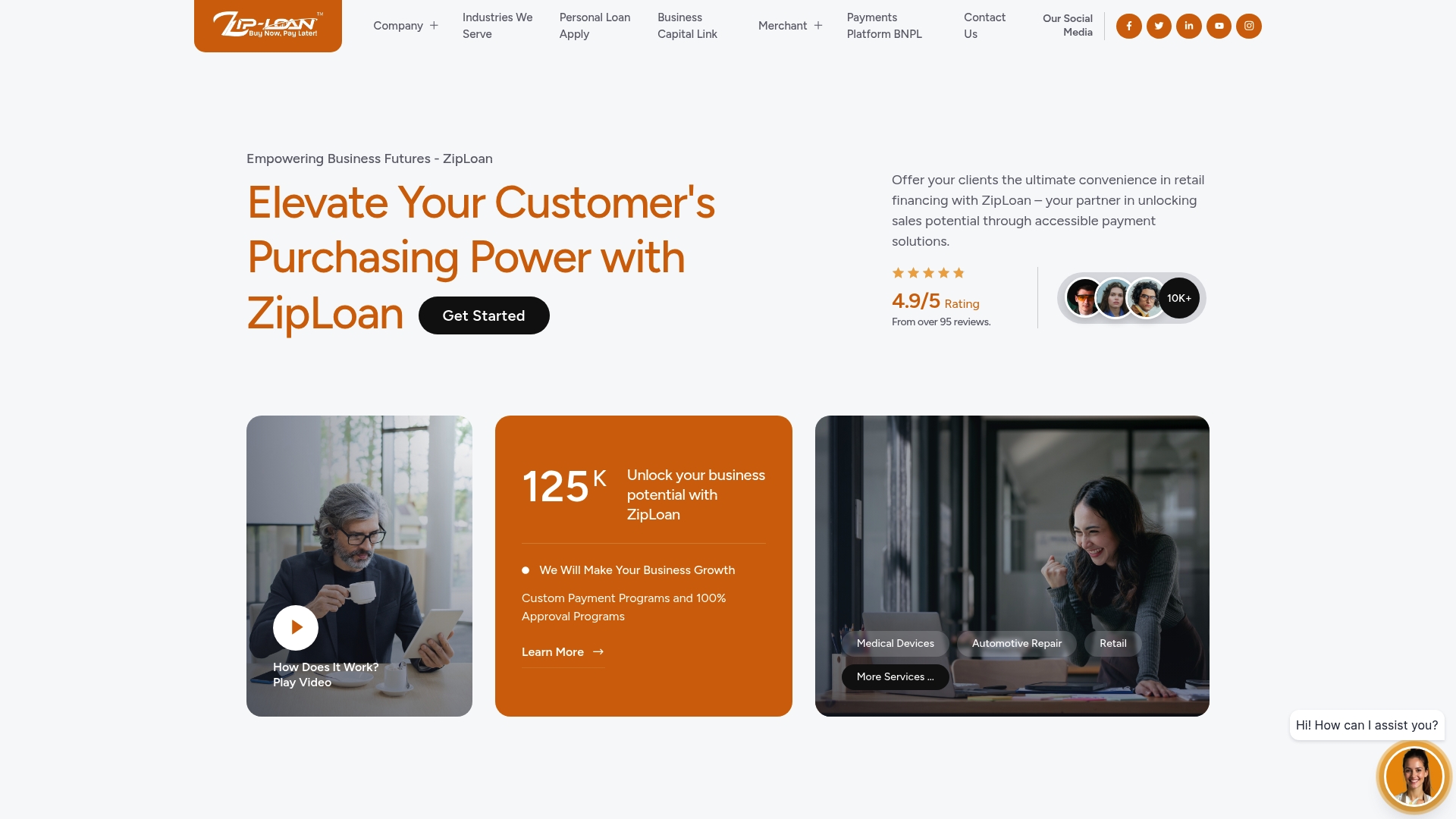
If shoppers are leaving because of price, see how easy financing for all credit types works for your business, or start from zip-loan.com and tell us about your POS setup.
FAQ
Is Lightspeed Capital the same as customer financing?
No. Lightspeed Capital is a cash advance that goes to your business and is repaid from your daily card sales. Customer financing lets your shoppers pay you over time through a lender, and you are paid on their purchase.
Do I need Lightspeed Payments to get a Lightspeed Capital offer?
Yes, for U.S. merchants the program has been tied to Lightspeed Payments since launch. Merchants on integrated payments are reviewed automatically each month, and you receive an email if you qualify.
How fast do I get the money and how do I repay?
According to the support center, funds usually arrive within 1 to 2 business days after you accept. Repayment starts automatically 1 to 2 business days later, as a set percentage of each settled daily card batch.
Can I use checkout financing and Lightspeed Capital at the same time?
Yes, because they serve different purposes. One funds your operations, and the other lets customers pay for purchases in installments or through leasing. Check any funding agreement for terms about your payment processor before you change how you process sales.
Sources
- Lightspeed Builds on Financial Services, Expanding Lightspeed Capital in the US (PR Newswire, 2021)
- Lightspeed Capital Launches for U.S. Retail Customers (PR Newswire, 2020)
- Lightspeed Capital Support Center
- Le Groupe Brande Thrives with Lightspeed Capital (Retail Insider)
- Lightspeed launches new SMB loan offering with Stripe (BetaKit)
- Lightspeed Capital Review (United Capital Source)
- Lightspeed doubles down on growing capital business (The Logic)
- Lightspeed receivables purchase terms (SEC filing)
- POS Financing: What Small Businesses Must Know (Leslie Tayne)
- Contain Inc for Financing (LED Grow Lights Depot)
Recommended
- POS Financing Integration: How to Connect Financing to Checkout
- Shopify Financing Integration: Offer Customer Financing
- Square Financing Integration: Your Options for Customer Financing
- Clover Financing Integration: Options, Setup and Costs
Disclaimer: This article is provided by Zip Loan (Touch N Buy LLC d/b/a Zip Loan) for general informational and educational purposes only and does not constitute financial, legal, or professional advice. While we strive for accuracy, information may be incomplete, outdated, or subject to change without notice. Financing programs, rates, terms, and approvals vary by lender and applicant and are not guaranteed. Zip Loan makes no warranties regarding the information provided and, to the fullest ext