

If you run Square at the counter or online, “financing” can mean three different things: letting customers pay over time, borrowing money for your own business, or adding a third-party lender to your checkout. Square covers the first two in limited ways. The third, a multi-lender consumer financing layer that approves a wider range of credit profiles, usually means connecting a specialist platform to your existing setup. This guide separates the options so you can decide which one actually solves your problem.
TL;DR
- Square offers buy now, pay later through Afterpay, which suits smaller, short-term purchases. It does not replace longer installment loans, lease options or financing for lower credit scores.
- Square Loans is financing for your business, repaid from your Square sales. It is not a way for customers to finance a purchase.
- Square’s developer APIs handle payments, orders and checkout. Adding a third-party consumer lender typically means a hosted application link, a payment-method workflow at the register, or a connected platform.
- For higher-ticket work in auto repair, healthcare, home improvement, furniture or jewelry, a multi-lender waterfall approves more customers than a single lender can.
Table of Contents
- Three Things “Square Financing” Can Mean
- What Square Offers Out of the Box
- How Square Integrations Actually Work
- Why Single-Lender Financing Leaves Sales Behind
- Compliance Checks Before You Add Any Lender
- Our Perspective: Treat Financing as a Checkout Decision, Not a Processor Feature
- Choosing Your Setup: A Checklist
- A Realistic Rollout in Four Steps
- Add Multi-Lender Financing to Your Checkout
- FAQ
- Sources
Three Things “Square Financing” Can Mean
Search results for this topic mix up three separate products, and the confusion costs merchants time. Sort them first.
| Type | Who borrows | Who pays you | Example |
|---|---|---|---|
| Business loan | You | You receive the loan | Square Loans |
| Pay-in-four BNPL | Your customer | The provider pays you up front | Afterpay on Square |
| Consumer installment, lease or private label financing | Your customer | The lender funds you | Multi-lender platforms such as ZipLoan |
Only the second and third rows increase what your customers can afford at checkout. The first changes your balance sheet, not your conversion rate.
What Square Offers Out of the Box
Afterpay for in-person and online sales
Square sellers can offer pay-in-installments plans through Afterpay, according to Business News Daily’s Square review. Afterpay-style products are what the Consumer Financial Protection Bureau describes as typically a four-payment loan with no interest. That structure works well for apparel, accessories and small-ticket retail.
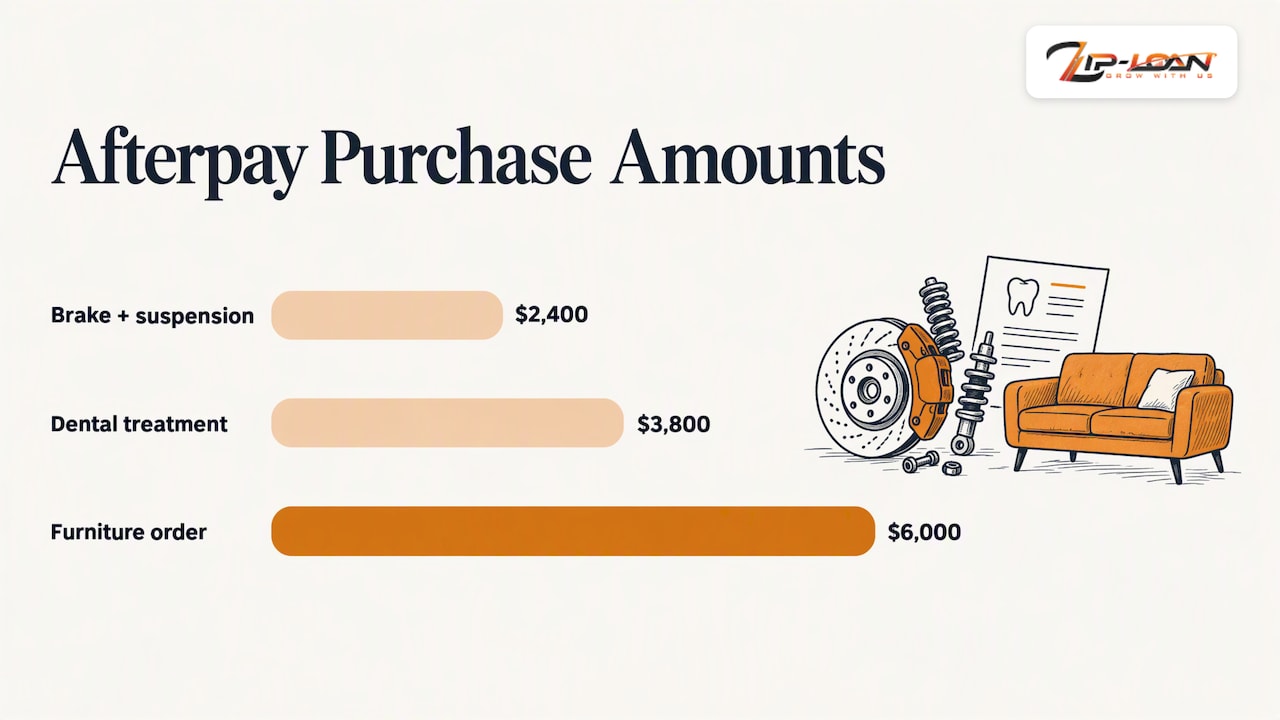
It works less well when a customer faces a $2,400 brake and suspension repair, a $3,800 dental treatment plan or a $6,000 furniture order. Four short payments rarely fit those amounts, and customers who need longer terms are the ones you lose at the register.
Square Installments, and why the history matters
Square launched its own consumer financing product in 2018. Payments Dive reported that Square Installments initially covered qualifying purchases between $250 and a capped upper amount at participating sellers in 22 states. Product availability changes, so check your own Square dashboard before assuming a given program is open to you. The broader lesson holds: a processor’s in-house financing is built for its own risk appetite, not for your customer mix.
Square Loans: financing for the merchant
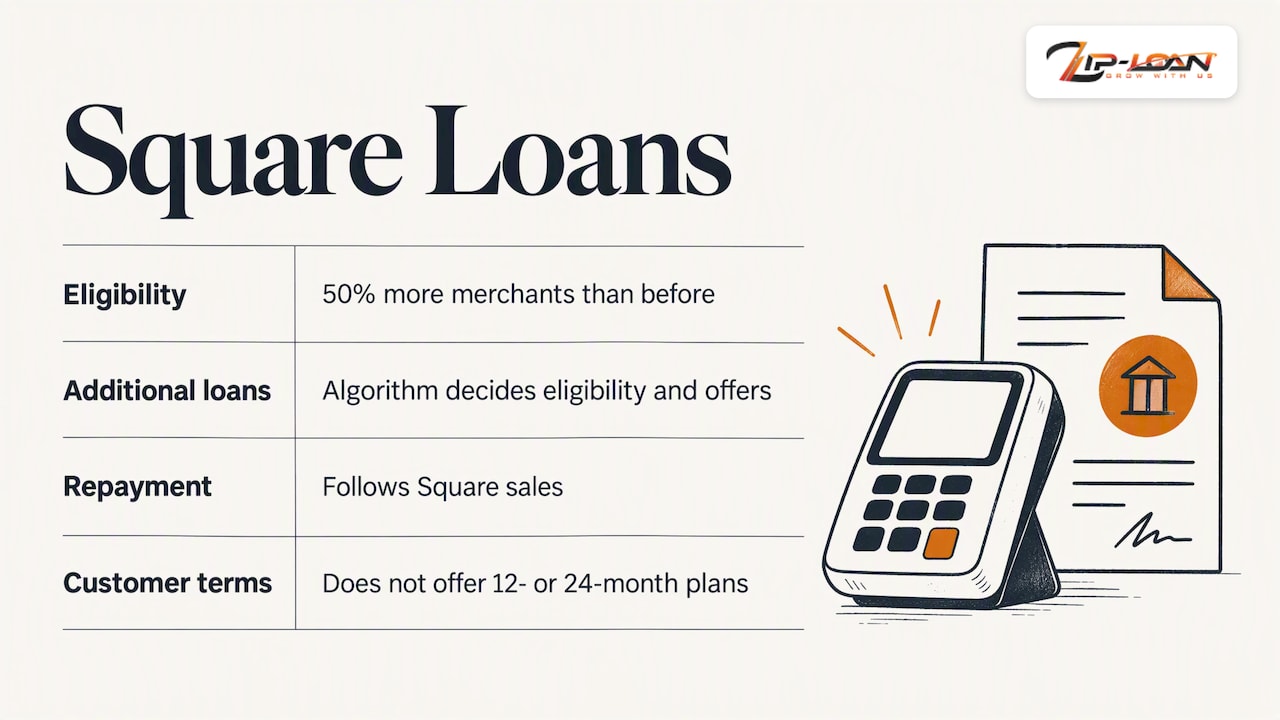
Square Loans is the product most people land on when they type “Square financing.” According to eMarketer’s coverage of a March 2026 announcement, Square said it would extend credit to 50% more Square merchants than were previously eligible. Per a Square Community answer, you cannot request an additional loan; Square’s own algorithm determines eligibility and whether further offers appear.
If you are comparing business funding on your side of the counter, a lender-matching resource such as this guide to questions lenders ask small business owners can help you prepare. The repayment structure matters: because repayment follows your Square sales, a slow month stretches the cash drag on you rather than on a customer’s plan.
Keep this in mind: Square Loans does nothing for the customer standing at your counter who needs 12 or 24 months to pay.
How Square Integrations Actually Work
Square’s developer reference describes APIs for payments, refunds, checkout, Terminal and devices, among others. In practice that gives you three integration patterns for adding outside consumer financing.
- Hosted application link. Staff or customers open a lender-hosted application from a link, QR code or text message. The sale is then recorded in Square as a payment received through an external method.
- Online checkout button. On a Square Online site or a custom storefront, a financing option appears beside card payment and routes the shopper to prequalification.
- Platform connection. A financing platform reads order data and sends funding status back to your records, so reconciliation does not depend on someone retyping invoices.
Whichever pattern you pick, decide in advance how a financed sale will be recorded in Square. Mixed tender, partial deposits and refunds on financed invoices are where bookkeeping errors begin.
Why Single-Lender Financing Leaves Sales Behind
A single lender approves the customers who fit its credit box and declines the rest. Declined customers rarely come back. In a multi-lender waterfall, one application is routed to a prime lender first, then down through near-prime and subprime options, and finally to lease-to-own or no credit check programs when appropriate. The customer sees one application and one result. You see more approved tickets.
This matters most in the verticals where a surprise bill is common:
- Automotive repair: a transmission or collision job that arrives unplanned. See our auto repair payment plans guide.
- Healthcare: out-of-pocket procedures and deductibles. See our medical financing overview.
- Home improvement, furniture and jewelry: large tickets where terms decide the purchase.
A second chance also matters. Our guide to second look financing explains how declined applicants can be routed to additional lenders so that a no from the first one is not the end of the sale.
Compliance Checks Before You Add Any Lender
Financing at checkout puts you inside a regulated flow, even when the lender carries the credit risk.
- Vet every marketing partner. The FTC’s staff perspective from its Strictly Business Forum says that using intermediaries or lead generators does not shield a business from liability, so you need to audit how your financing partners advertise. Ask for their approved marketing language and keep your counter signage consistent with it.
- Understand the customer data. The CFPB has noted that BNPL providers collect granular consumer data, and that this practice is under growing regulatory scrutiny. Ask any provider what it collects, what it shares and what appears in your own customer records.
- Watch stacking. The same CFPB report observes that BNPL use concentrates among consumers who already carry other unsecured debt. A lender that screens for existing obligations protects your customer and your reputation.
- Track performance. The CFPB’s 2025 market report shows BNPL charge-off rates falling to 1.83% in 2023 from 2.63% in 2022, which points to better underwriting. These are industry figures for six large BNPL companies, not a promise about any specific program.
For legal questions about disclosures, state licensing or adverse action notices, talk with your attorney or compliance advisor before launch.
Our Perspective: Treat Financing as a Checkout Decision, Not a Processor Feature
We work with merchants who started by asking what their POS already offered, and the answer is usually a good start. Pay-in-four covers a real slice of purchases. The trouble begins when a merchant tries to stretch that one product across every price point and every credit profile.
Our approach at ZipLoan is built around the opposite principle: your customers differ, so your financing should too. We offer single-lender and multi-lender programs for all credit types, with custom payment programs and integration with POS and ecommerce systems. Whether a customer is prime, thin-file or rebuilding, the goal is the same: a clear answer at the point of decision, not a decline that ends the conversation.
Our practical advice for Square merchants:
- Keep Square as your payments and inventory system. It is good at that job.
- Put your average ticket in front of you. If most financed jobs sit under a few hundred dollars, pay-in-four may be enough. If your tickets run to thousands, you need longer terms.
- Add a multi-lender option for the customers Square’s built-in tools do not serve.
- Measure the result by approved volume and average ticket, not by the number of applications.
— Joe
Choosing Your Setup: A Checklist
Before you commit to any provider, ask for answers to these questions in writing.
- Which credit profiles are approved, and does the platform include lease and no credit check options?
- Is funding non-recourse, meaning the lender, not you, carries the risk if the customer defaults?
- How are you paid, how fast, and how does it appear in your Square records?
- What do staff do at the register: send a link, scan a code, or key in a number?
- Can you set custom payment programs by product line or ticket size?
- What fees do you pay, per transaction or monthly, and what do customers pay?
- Who supports your team during setup and afterward?
If you want a fuller framework, our retail payment plan comparison and consumer financing buying guide for small business walk through the evaluation step by step. For the technical side, read how to integrate financing on your site.
A Realistic Rollout in Four Steps
- Map your declines. Look at the last 90 days of abandoned or deferred jobs above a threshold you choose. That is your addressable pool.
- Choose a program structure. Single-lender is simpler; multi-lender captures more approvals. Our merchant guide to setting up customer financing covers the decision.
- Check enrollment requirements. Review the merchant financing program requirements so documentation is ready before you apply.
- Train the counter. Staff should present financing early, as a normal payment option, and never promise approval before the lender decides.
Add Multi-Lender Financing to Your Checkout
ZipLoan is a platform for retail businesses and service providers to offer third-party consumer financing at checkout: installment loans, lease options, no credit check financing and private label credit, with integration into POS and ecommerce systems. If you want to see how it fits your current Square workflow, start with our guide to offering payment plans for customers or visit zip-loan.com to talk with our team.
FAQ
Does Square offer financing for my customers?
Square sellers can offer installment payments through Afterpay, according to Business News Daily. Availability of other programs varies, so confirm in your Square dashboard. For longer terms or a broader range of credit profiles, merchants generally add a separate consumer financing provider.
Is Square Loans the same as customer financing?
No. Square Loans funds your business, and per a Square Community answer its algorithm decides eligibility. Customer financing lets your buyer pay over time while a lender pays you.
Can I use another financing provider if I process payments with Square?
Generally yes, because Square publishes APIs for payments, orders and checkout that other systems can build around. The details depend on the provider, so ask how financed sales will be recorded in Square before you sign.
Do I carry the risk when a customer finances through a lender?
That depends on the program terms. Ask whether funding is non-recourse and under what conditions a transaction can be reversed. You remain responsible for how financing is advertised, so review the FTC guidance on partner liability.
Sources
- Square POS Review and Pricing Plans, Business News Daily
- Square API Reference
- Square Loans to expand credit opportunities, eMarketer
- Can you add to your loan, Square Community
- Square gets into consumer finance with Square Installments, Payments Dive
- CFPB BNPL Market Report, December 2025
- CFPB BNPL Market Trends and Consumer Impacts, September 2022
- FTC Strictly Business Forum Staff Perspective
Recommended
- Types of Customer Financing Options
- Integrate Financing on Your Site for Business Growth
- 2026 Merchant Guide to Setting Up Customer Financing
- Best Customer Financing for Small Business: 2026 Guide
Disclaimer: This article is provided by Zip Loan (Touch N Buy LLC d/b/a Zip Loan) for general informational and educational purposes only and does not constitute financial, legal, or professional advice. While we strive for accuracy, information may be incomplete, outdated, or subject to change without notice. Financing programs, rates, terms, and approvals vary by lender and applicant and are not guaranteed. Zip Loan makes no warranties regarding the information provided and, to the fullest ext